
H.M. Anil Kumar,
V. Venkata Raman,
Mahendra K C,
Sreenivasa C.G,
- Associate Professor, Department of Mechanical Engineering, Ballari Institute of Technology and Management, Ballari, Karnataka, India
- Professor, Department of Mechanical Engineering, Ballari Institute of Technology and Management, Ballari, Karnataka, India
- Assistant Professor, Department of Mechanical Engineering, RYM Engineering College, Ballari, Karnataka,
- Associate Professor, Department of Mechanical Engineering, University BDTCE, Davanagere, Karnataka, India
Abstract
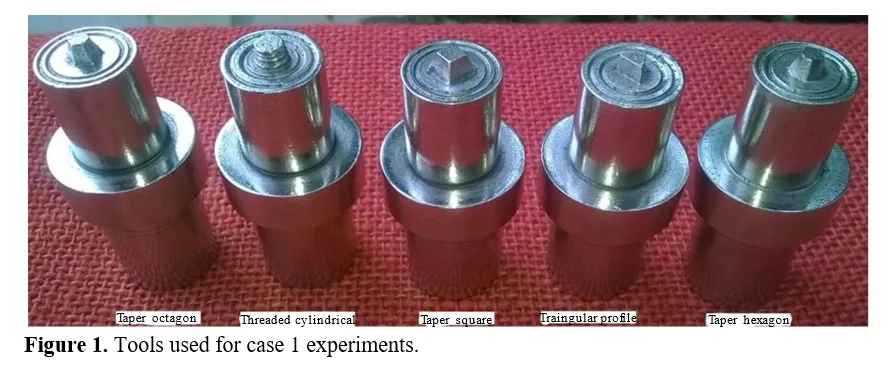
Aluminium 5083 alloys were mainly used for naval based applications because of better corrosion resistance feature. Similarly aluminium 6082 alloy being a structurally significant material found its applications in construction sector. Fusion welding of these two heterogeneous alloys is bit hard, since it evolves many defects. Present Investigation deals with two cases of distinct alloys through FSW process. Case 1 represents 31 experimental trails performed by 5 various tool pin geometry. Case 2 Emphasized on 20 trails considering single profiled tool. Testing carried out for both the cases on Response surface methodology and ANOVA, to determine adequacy of the model suggested. Experimentation revealed a critical parameter such as taper square tool of 18mm shoulder dia possessing at rotational speed of 1000 rpm and welding speed of 90 mm/min, tensile strength exhibits significant response. Offsetting the tool resulted in less significant contributions on tensile properties. Tilt angle reported considerable results with in strengthening the mechanical characteristics. Shoulder diameter contributed for considerable improvement of overall strength of the joint strength. Further, rotational speeds of the tool played influential role in producing better tensile properties. Response graphs indicated that tensile elongation was initially high at low rotational speeds, decreases when Rotational speeds increase.
Keywords: FSW, tensile strength, elongation, tool offset, shoulder diameter.
[This article belongs to Special Issue under section in Journal of Polymer & Composites (jopc)]
References
- Hassan AM, Qasim T, Ghaithan A. Effect of pin profile on friction stir welded aluminum matrix composites. Materials and Manufacturing Processes. 2012 Dec 1;27(12):1397-401.
- Daniolos NM, Pantelis DI. Microstructural and mechanical properties of dissimilar friction stir welds between AA6082-T6 and AA7075-T651. The International Journal of Advanced Manufacturing Technology. 2017 Feb;88:2497-505.
- Sundaram NS, Murugan N. Tensile behavior of dissimilar friction stir welded joints of aluminium alloys. Materials & Design. 2010 Oct 1;31(9):4184-93.
- Reza-E-Rabby, Md., Tang, W., Reynolds, A.P.:Effects of thread interruptions on tool pins in friction stir welding of A6061. Sci. Technol. Weld. Join. (2017).
- Jagathesh, K., Jenarthanan, M.P., Dinesh Babu, P., Chanakyan, C.:Analysis of factors influencing tensile strength in dissimilar welds of AA2024 and AA6061 produced by Friction Stir Welding(FSW). Aust. J. Mech. Eng. 15(1), 19–26 (2017).
- Rajakumar, S., Balasubramanian, V.: Establishing relationships between mechanical properties of aluminium alloys and optimised friction stir welding process parameters. Mater. Des. 40, 17–35 (2012).
- Ahmeda, M.M.Z., Atayaa, S., El-Sayed Seleman, M.M., Ammara, H.R., Ahmeda, E.: Friction stir welding of similar and dissimilar AA7075 and AA5083. J. Mater. Process. Technol. 242, 77–91 (2017).
- Saravanan,S. Rajakumar, Nilotpal BanerjeeR. Amuthakkannan, Effect of shoulder diameter topin diameter ratio on microstructure and mechanical properties of dissimilar friction stir welded AA2024-T6 and AA7075-T6 aluminum alloy joints, Int J Adv Manuf Technol (2016) 87:3637–3645.
- G. Cole , A. Fehrenbacher ,N. A. Duffie ,M. R. Zinn, F. E. Pfefferkorn, N.J. Ferrier, Weld temperature effects during friction stir welding of dissimilar aluminum alloys 6061-t6 and 7075-t6, Int J Adv Manuf Technol (2014) 71:643–652.
- S. Hassan, T. S. Mahmoud, F. H. Mahmoud &T. A. Khalifa Friction stir welding of dissimilar A319 and A356 aluminium cast alloys, Science and Technology of Welding and Joining, (2010) 15:5, 414-422.
- Ghosh , K. Kumar , S.V. Kailas , A.K. Ray, Optimization of friction stir welding parameters for dissimilar aluminum alloys, Materials and Design 31 (2010) 3033–3037.
- -K. Park,S.-T. Hong, J.-H.Park,K.-Y. Park, Y.-J. Kwon &H.-J.Son, “Effect of material locations on properties of friction stir welding joints of dissimilar aluminium alloys”, Science and Technology of Welding and Joining (2010), 15:4, 331-336.
- Rajakumar a, C. Muralidharan , V. Balasubramanian, Influence of friction stir welding process and tool parameters on strength properties of AA7075-T6 aluminium alloy joints , Materials and Design 32 (2011) 535– 549.
- Huijie Liu &Huijie Zhang & Qing Pan & Lei Yu, Effect of friction stir welding parameters on microstructural characteristics and mechanical properties of 2219-T6 aluminum alloy joints, Int J Mater Form (2012) 5:235–241.
- Astarita,A. Squillace,andL. Carrino.“Experimental Study of the Forces Acting on the Tool in the Friction-Stir Welding of AA 2024 T3 Sheets”, JMEPEG (2014) 23:3754–3761.
- C. Hou , H. J. Liu , Y. Q. Zhao, “Influences of rotation speed on microstructures and mechanical properties of 6061-T6 aluminum alloy joints fabricated by self-reacting friction stir welding tool ”, Int J Adv Manuf Technol (2014) 73:1073–1079.
- ŞefikaKasman &ZaferYenier,“Analyzing dissimilar frictionstirweldingofAA5754/AA7075”,Int J Adv Manuf Technol (2014) 70:145–156.
- Beytullah Gungor, Erdinc Kaluc, Emel Taban, Aydin Sik, Mechanical, fatigue and microstructural properties of friction stir welded 5083-H111 and 6082-T651 aluminum alloys, Materials and Design 56 (2014) 84–90.
- Hariharan and R.J. Golden Renjith Nimal, Friction Stir Welding Oof Dissimilar Aluminium Alloys (6061&7075) ByUsing Computerized Numerical Control Machine, Middle-East Journal of Scientific Research 20(5):601-605,2014.
- Heena K Sharma, Kamlesh Bhatt, Krunal Shah Unnati Joshi, “Experimental Analysis of Friction Stir Welding of Dissimilar Alloys AA6061 and Mg AZ31”, Procedia Technology 23 ( 2015 ) 566 – 572.
- Shirazi , Sh. Kheirandish , M.A. Safarkhanian, “Effect of process parameters on the macrostructure and defect formation in friction stir lap welding of AA5456 aluminum alloy ”, Measurement 76 (2015) 62–69.
- Mohammad K. Sued, and Dirk J. Pons, Dynamic Interaction between Machine, Tool, and Substrate in Bobbin Friction Stir Welding, Hindawi Publishing Corporation International Journal of Manufacturing Engineering Volume 2016, Article ID 8697453, 14 pages http://dx.doi.org/10.1155/2016/8697453.
- Mastanaiah, Abhay Sharma, G. Madhusudhan Reddy, Dissimilar Friction Stir Welds in AA2219-AA5083 Aluminium Alloys: Effect of Process Parameters on Material Inter-Mixing, Defect Formation, and Mechanical Properties, Trans Indian Inst Met (2016) 69(7):1397–1415.
- A. Dragatogiannis, E.P.Koumoulos, I. A. Kartsonakis, D.I. Pantelis,P. N. Karakizis&C. A.Charitidis(2016) Dissimilar Friction Stir WeldingBetween 5083and6082Al Alloys Reinforced With TiC Nanoparticles, Materials and Manufacturing Processes, 31:16, 2101-2114.
- Vahid MoosabeikiDehabadi, Saeede Ghorbanpour, Ghasem Azimi, Application of artificial neural network to predict Vickers microhardness of AA6061 friction stir welded sheets, J. Cent. South Univ. (2016) 23:2146−2155.
- P H Shah, Dr. Vishvesh Badheka, An experimental investigation of temperature distribution and joint properties of Al 7075 T651 friction stir welded aluminium alloys, Procedia Technology23 ( 2016 ) 543 – 550.
- Jagathesh, M.P. Jenarthanan, P. Dinesh Babu & C. Chanakyan (2017) Analysis of factors influencing tensile strength in dissimilar welds ofAA2024 andAA6061 produced by Friction Stir Welding(FSW), Australian Journal of Mechanical Engineering, 15:1, 19-26.
- M.Z. Ahmed,, Sabbah Ataya, M.M. El-Sayed Seleman, H.R. Ammar ,Essam Ahmed, Friction stir welding of similar and dissimilar AA7075 and AA5083, Journal of Materials Processing Technology 242 (2017) 77–91.
- Abdel-Wahab El-Morsy, Mohamed M. Ghanem, Haitham Bahaitham, Effect of Friction Stir Welding Parameters on the Microstructure and Mechanical Properties of AA2024-T4 Aluminum Alloy, Engineering, Technology & Applied Science Research Vol. 8, No. 1, 2018, 2493-2498.
- Guoqiang Huang, Dongxu Cheng, Haoming Wang, Qihui Zhou & Yifu Shen (2019): Effect of tool probe with a discat the top on the microstructure and mechanical properties of FSW joints for6061-T6aluminumalloy, Journal of Adhesion Science and Technology.
- B. Wang, P. Xue, B. L. Xiao, W. G. Wang, Y. D. Liu & Z. Y. Ma (2019): Achieving equal fatigue strength to base material in a friction stir welded 5083-H19 aluminium alloy joint, Science and Technology of Welding and Joining.
- H.Li, L. Zhou, S. F. Luo, Z. Y. Du, J. C. Feng &F. X.Meng (2019):Microstructure and mechanical properties of self-reacting friction stir welded AA2219-T87 aluminium alloy, Science and Technology of Welding and Joining.
- Mohamed M. Abd Elnabi, Abou Bakr Elshalakany, M.M. Abdel-Mottaleb, T.A. Osman, A. El Mokadem,Influence of friction stir welding parameters on metallurgical and mechanical properties of dissimilar AA5454– AA7075 aluminum alloys, j mater res technol . 2 0 1 9; 8(2):1684–1693.
- M.Anil Kumar, V. VenkataRaman,S.P.Shanmughanathan,JacobJohnandU.MohammedIqbalOptimization of Dissimilar Friction Stir Welding Process Parameters of AA5083-H111 and AA6082-T6 by CCD-RSM Technique, Springer Nature Singapore Pte Ltd. 2019, Advances in Manufacturing Processes, Lecture Notes in Mechanical Engineering, https://doi.org/10.1007/978-981-13-1724-8_5.
- M. Anil Kumar , V. Venkata Ramana, Influence of tool parameters on the tensile properties of friction stir welded aluminium 5083 and 6082 alloys, Materials Today: Proceedings27, Part 2 (2020) 951-957, doi.org/10.1016/j.matpr.2020.01.270.
- Landry Giraud, Hugo Robe, Christophe Claudin, Christophe Desrayaud, Philippe Bocher, Eric Feulvarch, Investigation into the dissimilar friction stir welding of AA7020-T651 and AA6060-T6, Journal of Materials Processing Technology 235 (2016) 220–230.
- Bazani Shaik , G. Harinath Gowdand B. Durga Prasad, Investigations and optimization of friction stir welding process to improve microstructures of aluminum alloys, Cogent Engineering (2019), 6: 1616373.
- Elangovan K, Balasubramanian V, Valliappan M. Influences of pin profile and axial force on the formation of friction stir processing zone in AA6061 aluminium alloy. Int J Adv Manuf Technol 2008;38(3-4).
- Lomolino S, Tovo R, Dos Santos J. On the fatigue behavior and design curves of friction stir butt welded Al alloys. Int J Fatigue 2005;27:305–16.
- Benavides S, Li Y, Murr LE, Brown D, McClure JC. Low-temperature friction-stir welding of 2024 aluminum. Scripta Mater 1999;41(8):809–15.
- Threadgill P. Friction stir welds in aluminium alloys preliminary microstructural assessment, TWI Bulletin-The Welding Institute, Abington, UK; 1997: Industrial report no: 513/2/97.
- Colligan J, Paul J, Konkol, James J, Fisher, Pickens Joseph R. Friction stir welding demonstrated for combat vehicle construction. Weld J 2003:1–6.
- Palanivel, P. Koshy Mathews, N.Murugan, Optimization of process parameters to maximize ultimate tensile strength of friction stir welded dissimilar aluminum alloys using response surface methodology, J. Cent. South Univ. (2013) 20: 2929−2938.
- Ouyang JH, Kovacevic R. Material flow and microstructure of the friction stir butt welds of the same and dissimilar aluminum alloys. J Mater Eng Perform 2002;11(1):51–63.
- Zhang Z, Zhang HW. Numerical studies on effect of axial pressure in friction stir welding. Sci Technol Weld Joining 2007;12(3):226–48.
- Masoud Ahmadnia& Saeid Shahraki& Mojtaba Ahmadi Kamarposhti, Experimental studies on optimized mechanical properties while dissimilar joining AA6061 and AA5010 in a friction stir welding process, Int J Adv Manuf Technol (2016) 87:2337–2352.
- Sato YS, Urata M, Kokawa H, Ikeda K. Hall–petch relationship in friction stir welds of equal channel angular- pressed aluminium alloys. Mater Sci Eng 2003;A354:298–305.
- Srivatsan TS, Satish Vasudevan, Lisa Park. The tensile deformation and fracture behavior of friction stir welded aluminum alloy 2024. Mater Sci Eng A 2007;466:235–45.
- I.Costa, C.Leitao, D.M.Rodrigues, Influence of post-welding heat-treatment on the monotonic and fatigue strength of 6082-T6 friction stir lap welds, Journal of Materials Processing Tech. 250 (2017) 289–296

Journal of Polymer & Composites
| Volume | 13 | |
| Special Issue | 02 | |
| Received | 20/09/2024 | |
| Accepted | 21/12/2024 | |
| Published | 11/01/2025 | |
| Publication Time | 113 Days |