Gaytri Dhaker,
Sarvesh Kumar Singh,
Kshipra Rajoria,
Rahul Dandiya,
- P.G. Scholar, Department of Panchkarma, The National Institute of Ayurveda, Jaipur, Rajasthan, India
- Associate Professor, Department of Panchkarma, The National Institute of Ayurveda, Jaipur, Rajasthan, India
- Assistant Professor, Department of Panchkarma, The National Institute of Ayurveda, Jaipur, Rajasthan, India
- P.G. Scholar, Department of Panchkarma, The National Institute of Ayurveda, Jaipur,, Rajasthan, India
Abstract
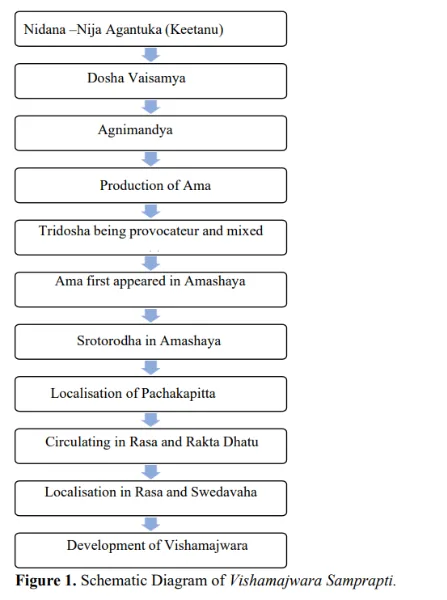
Malaria fever, known as Vishama Jwara in Ayurveda, is a significant global health challenge caused by the Plasmodium species transmitted via Anopheles mosquitoes. While conventional medicine has advanced in diagnosing and treating malaria, exploring it through the Ayurvedic perspective offers valuable insights into its holistic understanding and management. Ayurveda describes Vishama Jwara as a fever with irregular patterns, aligning with the cyclical febrile episodes seen in malaria. This review delves into Ayurvedic texts to analyze the etiology, pathology, and therapeutic approaches to Vishama Jwara. The Ayurvedic framework attributes the condition to imbalances in the Tridoshas – Vata, Pitta, and Kapha – aggravated by factors like poor digestion, environmental influences, and lifestyle choices. Key concepts, such as Ama (toxins), disrupted Agni (digestive fire), and impaired Ojas (vital essence) are discussed as foundational to disease progression. Classical formulations like Sudarsana Churna, Maha Sudarsana Kadha, and interventions involving antipyretic, detoxifying, and immune-boosting herbs, including Guduchi (Tinospora cordifolia), Kalmegh (Andrographis paniculata), and Tulsi (Ocimum sanctum), are explored for their therapeutic relevance. Additionally, preventive measures rooted in Ayurvedic principles, such as lifestyle modifications, dietary adjustments, and the use of mosquito-repellent herbs, are emphasized. Integration with modern biomedical approaches, such as antimalarial drugs and vector control strategies, is highlighted to enhance outcomes. This comprehensive review underscores Ayurveda’s potential in offering a personalized, preventive, and adjunctive approach to malaria management. By bridging traditional and contemporary paradigms, it aims to inspire further research and collaborative frameworks for addressing malaria as a complex, multifaceted disease.
Keywords: Vishama Jwara, Malarial Fever, Plasmodium vivax
[This article belongs to Journal of AYUSH: Ayurveda, Yoga, Unani, Siddha and Homeopathy ]
References
- Abbas Rajabifard, Paez D, Foliente G. COVID-19 Pandemic, Geospatial Information, and Community Resilience [Internet]. CRC Press; 2021. Available from: https://www.who.int/publications/i/item/9789241565653
- Krishna Das KV. Textbook of Medicine, edited by K.V. Krishna Das, 5th Ed, Jaypee Brothers Medical Publishers (P) Ltd; 1466.Page No359.
- Agnivesha, Charak Samhita, Edited by Yadavaji Trikamji Acharya. Choukambha Publication. Varanasi Edition 2001. Chikitsa sthan Jwar Chikitsa, chapter 3.
- Dhiman S. Are malaria elimination efforts on right track? An analysis of gains achieved and challenges ahead. Infect. Dis. Poverty. 2019 Dec;8:1–9.
- Agnivesha, Charak Samhita, Edited by Yadavaji Trikamji Acharya. Varanasi: Choukambha Publication; c2001. p. 738–405.
- Chudasama Hardik, Rai Pankaj, Yadav C.R. Analytical review on influence of Krodha (Anger) on Agni – A Contemporary study. Ayushdhara. 2022 Jul8;9(3):62–6.
- Acharya SDASG, Acharya VYT. Chaukambha Sanskrit Sansthan; c2002. p. 824–675.
- Agnivesha, Charaka Samhitha, revised by Charaka and Dridhabala with Sri Chakrapanidatta Ayurvedadipika Commentary in Sanskrit edited by Vaidya Jadhavji Trikamji Acharya. Choukambha Sanskrit Sansthan, Varanasi, Vth Edition, 2001;p.339.
- Sushrutha M. Sushrutha Samhi- hi-ta, 7 ed., Varanasi U.P: Sri Dalhana Achary a Sri Gayadas Acharya, Vaidya Yadavji Trikamji Acharya, Chaukambha Sanskrit Sansthan; c2002. p. 824–27.
- Vagbhatacharya, Hridaya A, Kunte AM. Varanasi: Choukambha Publication; c2000.p.956–464.
- Sushrutha M. Sushrutha Sam- hita, 7thed, Varanasi U.P: Sri Dalhana Acharya Sri Gayadas Acharya, Vaidya Yadavji Trikamji Acharya, Chaukambha Sanskrit Sansthan; c2002. p. 824–642.
- Nagaraj S, Nidhin V. A critical study on the aetiopathogenesis of vishama Jwara W.S.R to malarial fever. p. 201, page no. 168.
- Hrudayam A, Sundara S. Commentary of Arunadatta and Ayurveda rasayana of Hemadri. Edited by Bhisagacharya Hari Shastri Paradakara Vaidya; 8th edition; Varanasi: Chaukhamba Orientalia; c2009.
- Sharma PV. (English editor-translator. Charaka Samhitha). Varanasi: Choukamba Orientalia; [Chikitsa sthana; 3/4], [Chikitsa sthana; 3/31]; c1998. p. 2.
- Kumar S. A Review Article on Langhana in Jwara through Upavasa. Int Ayurvedic Med J (online) (cited March 2022); c2022. Available from: http://www.iamj.in/posts/images/upload/630_633.pdf
- Samhita C, Deepika A. Commentary of Chakrapanidatta. Edited by Vaidya Jadavji Trikamji Acharya, 8th edition. Varanasi: Chaukhamba Sanskrit Sansthana; c2005.
- Al-Zanbagi NA. Review of malaria in Saudi Arabia, current status and future prospects. J Int Acad Res Multidiscip. 2014 Sep 1;2(2):1-5.
- Hrudayam A, Sundara S. Commentary of Arunadatta and Ayurveda rasayana of Hemadri. Edited by Bhisagacharya Hari Shastri Paradakara Vaidya. 8th edition. Varanasi: Chaukhamba Orientalia; c2009.
- Garba IH, Gatsing D. Malaria: Cause and control. International Journal of Biomedical and Pharmaceutical Sciences. 2007;1(1):12-9.
Journal of AYUSH: Ayurveda, Yoga, Unani, Siddha and Homeopathy
| Volume | 13 | |
| Issue | 03 | |
| Received | 08/12/2024 | |
| Accepted | 24/12/2024 | |
| Published | 28/12/2024 | |
| Publication Time | 20 Days |