
Open Access
Anuj Goyal,
Deepak Kumar Tiwari,
- Assistant Professor, Civil Engineering Department, GLA University, Mathura, Uttar Pradesh, India
- Assistant Professor, Civil Engineering Department, GLA University, Mathura, Uttar Pradesh, India
Abstract
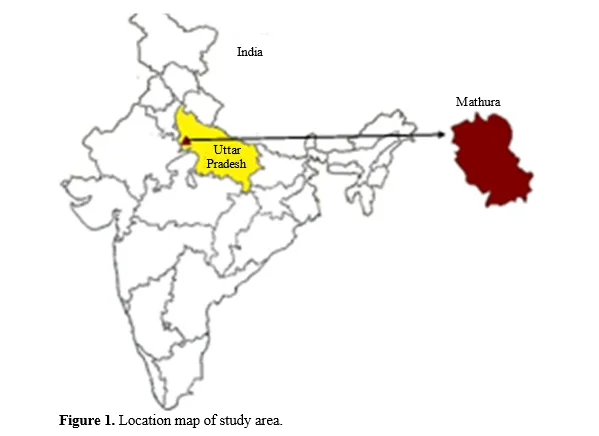
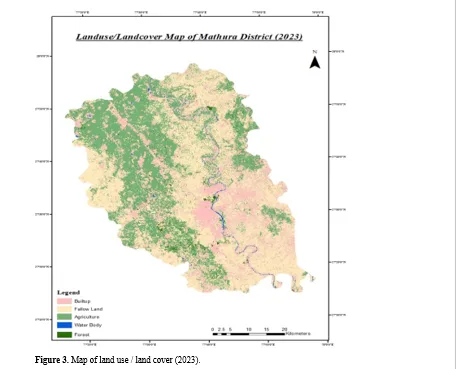
Polymer-based mapping approaches are utilized in this study to improve the accuracy and consistency of LULC classification. Utilizing the special qualities of polymers like their elasticity, robustness, and adaptability, we create a strong framework for mapping LULC dynamics. Over the past few years, the district of Mathura in the state of Uttar Pradesh has experienced substantial expansion and development. This study assessed the change detection and estimated the shift in land-use/cover for the duration of 2013–2023. Five main classifications have been identified from the land-use/land cover data obtained from satellite image: (i) Built-up; (ii) Fallow; (iii) Agriculture; (iv) Water Bodies; and (v) Forest. The use of the Landsat sensors from 2013 and 2023 with a Geoinformatics methodology aided the investigation. Observations of land-use and spread revealed that changes in the land under different classes over a ten-year period were more notable in degree. The rise of built-up and barren land is the most striking change. Along with this decrease in the amount of land used for agriculture, water bodies, and forests. The findings show a significant shift in the areas covered by different land use classifications between 2013 and 2023. From 14.86 percent in 2013 to 23.04 percent in 2023, the built-up area grew. Between 2013 and 2023, the extent of fallow land rose from 296.96% to 42.96%. From roughly 50.09% of the total area in 2013 to 31.66% in 2023, there was less agricultural land. Between 2013 and 2023, the percentage of water bodies fell from 2.53% to 0.56%. Additionally, the forest area shrank from 2.84 percent in 2013 to 1.77 percent in 2023. The anthropogenic activities of urban expansion have resulted in significant problems for water bodies, forests, and agricultural land.
Keywords: Polymer coating, environmental monitoring, remote sensing, change detection, landsat sensor, land use/cover and GIS.
[This article belongs to Special Issue under section in Journal of Polymer & Composites (jopc)]


References
- Alberti G, Zanoni C, Losi V, Magnaghi LR, Biesuz R. Current Trends in Polymer Based Sensors. Chemosens 2021, Vol 9, Page 108 [Internet]. 2021 May 13 [cited 2024 May 16];9(5):108. Available from: https://www.mdpi.com/2227-9040/9/5/108/htm
- Alam MW, Bhat SI, Al Qahtani HS, Aamir M, Amin MN, Farhan M, et al. Recent Progress, Challenges, and Trends in Polymer-Based Sensors: A Review. Polymers (Basel) [Internet]. 2022 Jun 1 [cited 2024 May 16];14(11). Available from: https://www.researchgate.net/publication/361232149_Recent_Progress_Challenges_and_Trends_in_Polymer-Based_Sensors_A_Review
- Ouchra H, Belangour A, Erraissi A. Spatial Data Mining technology for GIS: a review. 2022 Int Conf Data Anal Bus Ind ICDABI 2022 [Internet]. 2022 [cited 2024 May 16];655–9. Available from: https://www.researchgate.net/publication/368518484_Spatial_Data_Mining_technology_for_GIS_a_review
- Rutten MGTA, Vaandrager FW, Elemans JAAW, Nolte RJM. Encoding information into polymers. Nat Rev Chem [Internet]. 2018 Nov 1 [cited 2024 May 16];2(11):365–81. Available from: https://www.researchgate.net/publication/328616168_Encoding_information_into_polymers
- Troha A. Changing settlement patterns in areas of autochtonous dispersed settlement. Igra ustvarjalnosti – Creat Game [Internet]. 2017 [cited 2024 May 16];2017(05):076–88. Available from: https://www.researchgate.net/publication/324508726_Changing_Settlement_Patterns_in_Areas_of_Autochtonous_Dispersed_Settlement
- Alphan H. Land-use change and urbanization of Adana, Turkey. L Degrad Dev. 2003 Nov;14(6):575–86.
- Anil NC, Sankar GJ, Rao MJ, Prasad IVRK V, Sailaja U. Studies on Land Use/Land Cover and change detection from parts of South West Godavari District, A.P-Using Remote Sensing and GIS Techniques. J Ind Geophys Union. 2011;15(4):187–94.
- Gautam NC, Narayan LRA. Landsat mss data for land use and land cover inventory and mapping: A case study of Andhra Pradesh. J Indian Soc Photo-Interpretation Remote Sens [Internet]. 1983 Sep [cited 2024 Feb 2];11(3):15–27. Available from: https://link.springer.com/article/10.1007/BF02990710
- Madariya SK, Pandey D, Sk S. A comparative study on supervised and unsupervised techniques of land use and land cover classification. ~ 517 ~ Pharma Innov J [Internet]. 2022 [cited 2024 May 16];(3):517–21. Available from: http://www.thepharmajournal.com
- Sarma VVLN, Murali Krishna G, Hema Malini B, Nageswara Rao K. Landuse/landcover change detection through remote sensing and its climatic implications in the Godavari delta region. J Indian Soc Remote Sens. 2001;29(1–2):85–91.
- Rane N, Giduturi M, Rane NL, Achari A, Choudhary SP. Effectiveness and Capability of Remote Sensing (RS) and Geographic Information Systems (GIS): A Powerful Tool for Land use and Land Cover (LULC) Change and Accuracy Assessment. Int J Innov Sci Res Technol [Internet]. 2023;8(4). Available from: www.ijisrt.com286
- Katkani D, Babbar A, Mishra VK, Trivedi A, Tiwari S, Kumawat RK. A Review on Applications and Utility of Remote Sensing and Geographic Information Systems in Agriculture and Natural Resource Management. Int J Environ Clim Chang. 2022 Feb 26;1–18.
- Goyal MK, Sharma A, Surampalli RY. Remote Sensing and GIS Applications in Sustainability. Sustain Fundam Appl. 2020 Jan 1;605–26.

Journal of Polymer & Composites
| Volume | 13 | |
| Special Issue | 01 | |
| Received | 23/04/2024 | |
| Accepted | 06/11/2024 | |
| Published | 14/11/2024 | |
| Publication Time | 205 Days |