
Open Access
Shashi Pandey,
Aparna Nadgowda,
Chitra Khade,
Purushottam Naktode,
- Research Scholar, Department of Physics, G H Raisoni University, Amravati, Maharashtra, India
- Research Scholar, Department of Physics, G H Raisoni University, Amravati-444701, Maharashtra, India
- Assistant Professor, Department of Physics, G H Raisoni University, Amravati-444701, Maharashtra, India
- Assistant Professor, Department of Physics, G H Raisoni Institute of Engineering and Technology, Nagpur -16, Maharashtra, India
Abstract
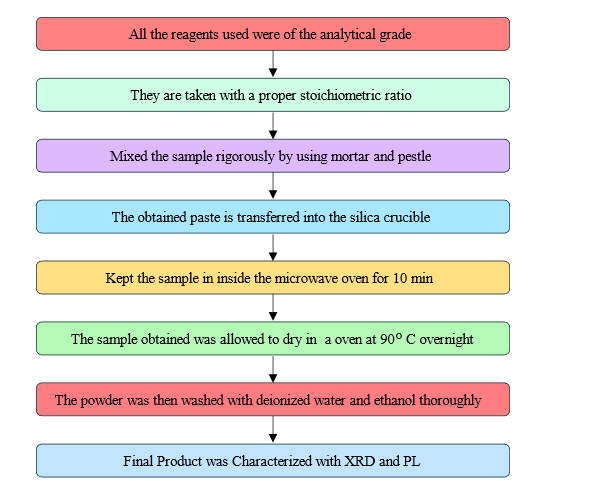
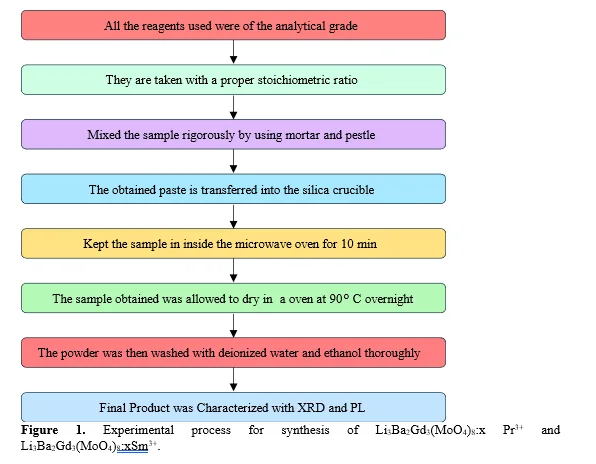
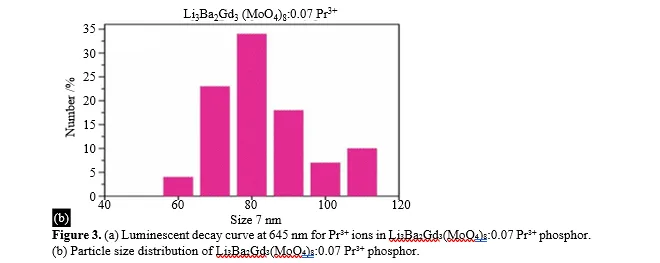
In this study, we report the successful synthesis of Li₃Ba₂Gd₃(MoO₄)₈ (RE³⁺ = Pr³⁺, Sm³⁺) phosphors using a novel, microwave-assisted solid-state reaction method at ambient temperature. The synthesis involved the use of analytical grade reagents including Lithium Nitrate (LiNO₃), Barium Nitrate, Gadolinium Nitrate (Gd(NO₃)₃·6H₂O), Ammonium Molybdate ((NH₄)₆Mo₇O₂₄·24H₂O), and high-purity oxides of Praseodymium (Pr₂O₃) and Samarium (Sm₂O₃). The reagents were mixed in stoichiometric ratios, ground thoroughly in a pestle and mortar, and then subjected to microwave irradiation for 10 minutes. The resultant powders were washed, dried, and ground again for further analysis. Under blue light excitation at 450 nm, the Li₃Ba₂Gd₃(MoO₄)₈:0.07Pr³⁺ phosphor exhibits a prominent red emission peak at 645 nm. The maximum optical intensity was obtained for 7 mol% doping concentration of both Pr³+and Sm³⁺ ions. Pr³⁺ ions, characterized by their 4f² electronic configuration, display a broad spectrum of emissions across different wavelengths: red emission from the ¹D₂ level, green from the ³P₀ level, blue from the ¹S₀ level, and ultraviolet from the 4f to 5d state transition. These multiple emission peaks indicate the versatility of Pr³⁺ ions in generating various colors under different excitation conditions. Similarly, when excited with near-UV light at 404 nm, the Li₃Ba₂Gd₃(MoO₄)₈:0.07Sm³⁺ phosphor demonstrates intense red emission lines at 605 nm. The optimal Sm³⁺ doping concentration was also determined to be 7 mol%. Sm³⁺ ions, with their 4f⁵ electronic configuration, exhibit intense orange-red fluorescence within the visible spectrum. This strong red emission is attributed to transitions from the ⁴G₅/₂ excited state to various lower-lying states such as ⁶H₅/₂, ⁶H₇/₂, and ⁶H₉/₂, resulting in the observed sharp emission peaks. Remarkably, the red emission intensities of these phosphors are comparable to that of the conventional Y₂O₂S³⁺ red phosphor, which is widely used in commercial applications. This comparison underscores the efficiency and potential of Li₃Ba₂Gd₃(MoO₄)₈:0.07Pr³⁺ and Li₃Ba₂Gd₃(MoO₄)₈:0.07Sm³⁺ phosphors as high-performance red-emitting materials. These findings highlight the potential of Li₃Ba₂Gd₃(MoO₄)₈:0.07Pr³⁺ and Li₃Ba₂Gd₃(MoO₄)₈:0.07Sm³⁺ phosphors for integration into near-UV and blue light GaN-based white LEDs. Their superior performance, stability, and compatibility with existing LED technology suggest that these phosphors could serve as promising candidates for next-generation solid-state lighting applications. The successful synthesis and characterization of these phosphors pave the way for further exploration and optimization of rare-earth-doped phosphors in advanced lighting technologies, potentially leading to more efficient and versatile lighting solutions.
Keywords: Luminescent, material, Red, Phosphors, SSM.
[This article belongs to Special Issue under section in Journal of Polymer & Composites (jopc)]
References
- Xia, Mao & Chen, Zhi & Gao, Peixing & Hintzen, Hubertus & Wong, Wai-Yeung & Wang, Jing & Zhou, Zhi. (2020). Pyrophosphate Phosphor Solid Solution with High Quantum Efficiency and Thermal Stability for Efficient LED Lighting. iScience. 23. 100892. 10.1016/j.isci.2020.100892.
- -J. Park, C.-H. Park, B.-Y. Yu, H.-S. Bae, C.-H. Kim, and C.-H. Pyun, “Structure and luminescence of SrY2O4:Eu,” Journal of the Electrochemical Society, vol. 146, no. 10, pp. 3903–3906, 1999.
- Atkins and A. L. Diaz, “Investigation of host-to-activator energy transfer and surface losses in SrY2O4:Eu3+ under VUV excitation,” Journal of Luminescence, vol. 128, no. 9, pp. 1463–1470, 2008.
- Li, Mengting & Jiao, Baoxiang. (2015). Synthesis and photoluminescence properties of ZnTiO3:Eu3+ red phosphors via sol-gel method. Journal of Rare Earths. 33. 10.1016/S1002-0721(14)60408-7.
- Wan, Z. Wang, X. Chen, L. Mu, and Y. Qu, “Shape-tailored photoluminescent intensity of red phosphor Y2O3:Eu3+,” Journal of Crystal Growth, vol. 284, no. 3-4, pp. 538–543, 2005.
- S. Ofelt, “Intensities of crystal spectra of rare‐earth ions,” The Journal of Chemical Physics, vol. 37, no. 3, article 511, 1962.
- Shanta Singh, R. S. Ningthoujam, G. Phaomei, S. D. Singh, A. Vinu, and R. K. Vatsa, “Re-dispersion and film formation of GdVO4 : Ln (Ln = Dy, Eu, Sm, Tm) nanoparticles: particle size and luminescence studies,” Dalton Trans. 41(15), 4404–4412 (2012).
- Chen H.L., Wei L.K., Chang Y.S. Characterizations of Pr3+ Ion-Doped LaVO4 Phosphor Prepared Using a Sol–Gel Method. Electron. Mater. 2018;47:6649–6654. doi: 10.1007/s11664-018-6561-6.
- Zhang L.Z., Hu Z.S., Lin Z.B., Wang G.F. Growth and spectral properties of Nd3+: LaVO4 J. Cryst. Growth. 2004;260:460–463. doi: 10.1016/j.jcrysgro.2003.08.067.
- Wang X.J., Wang X.J., Wang Z.H., Zhu Q., Zhu G., Wang C., Xin S.Y., Li J.G. Photo/cathodoluminescence and stability of Gd2O2S: Tb, Pr green phosphor hexagons calcined from layered hydroxide sulfate. Am. Ceram. Soc. 2018;101:5477–5486. doi: 10.1111/jace.15797.
- Zhi J., Chen A., Ju L.K. Long lasting phosphorescence behavior of Pr3+-doped CaTiO3-based oxides. Mater. 2009;31:1667–1672. doi: 10.1016/j.optmat.2009.04.004.
- Thirumalai J., Chandramohan R., Ahamed M.B., Ezhilvizhian S., Vijayan T.A. Pr3+ doped BaMoO4 octahedron to shuttle-like microcrystals: Synthesis and luminescence properties. Mater. Sci-Mater. El. 2012;23:325–333. doi: 10.1007/s10854-011-0415-9.
- Min X., Fang M.H., Huang Z.H., Liu Y.G., Tang C., Wu X.W. Synthesis and optical properties of Pr3+-doped LaMgAl11O19-A novel blue converting yellow phosphor for white light emitting diodes. Int. 2015;41:4238–4242. doi: 10.1016/j.ceramint.2014.11.070.
- Xi J., Xi K., Sadhanala A., Zhang K.H.L., Li G.R., Dong H., Lei T., Yuan F., Ran C.X., Jiao B., et al. Chemical sintering reduced grain boundary defects for stable planar perovskite solar cells. Nano Energy. 2019;56:741–750. doi: 10.1016/j.nanoen.2018.11.021.

Journal of Polymer & Composites
| Volume | 13 | |
| Special Issue | 01 | |
| Received | 15/05/2024 | |
| Accepted | 15/07/2024 | |
| Published | 25/10/2024 | |
| Publication Time | Days |