Supriya,
Pradeep Kumar,
- Student, Department of biotechnology, Chaudhary Charan Singh University, Meerut, Uttar Pradesh, India
- Assistant Professor, Department of biotechnology Chaudhary Charan Singh University, Meerut, Uttar Pradesh, India
Abstract
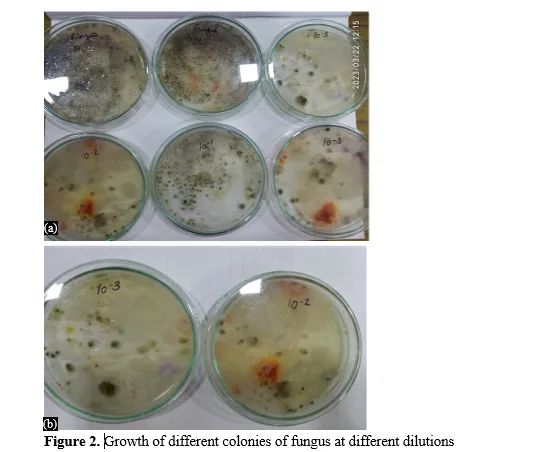
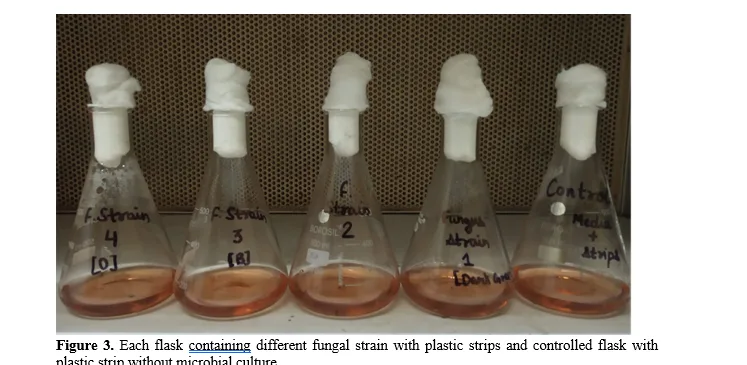
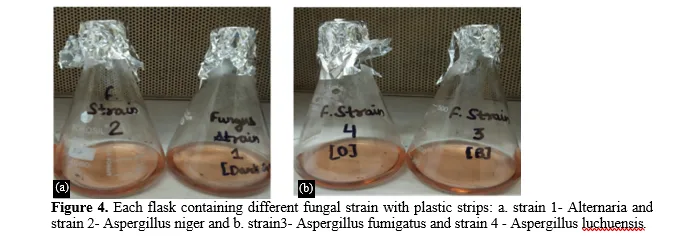
By isolating microorganisms from a dumpsite containing low-density polyethylene (LDPE), the potential for microbial decomposition of plastic waste was studied. Four different strains of Aspergillus niger (fungus) were identified and used to biodegrade plastic waste. The isolated fungal strains included Aspergillus niger, Alternaria, A. fumigatus, A. flavus, and A. luchuensis. Predominant fungal strains, Aspergillus niger and Alternaria, were selected for polyethylene degradation under laboratory conditions. In a controlled shaker culture, the efficiency of the breakdown of low-density polyethylene (LDPE) and various polymer composites commonly used in plastic products was investigated over an 8-week period. Biodegradation was assessed through mean weight loss and Fourier-transform infrared (FTIR) spectroscopy. The study revealed a weight loss of approximately 14.3% to 28.57% after 8 weeks. Specifically, the total weight loss after 60 days was 14.3% for Alternaria sp. and 28.57% for Aspergillus niger. The findings suggest that both Alternaria sp. and Aspergillus niger possess the ability to degrade plastics, including various polymer composites. Notably, Aspergillus niger demonstrated superior efficiency in plastic degradation compared to Alternaria sp. This study highlights the potential of using fungal strains for the biodegradation of LDPE and composite polymers, contributing to more effective plastic waste management strategies.
Keywords: Polythene, biodegradable polymers, microorganisms, enzymes, heterotrophic fungi.
[This article belongs to Journal of Polymer & Composites ]








References
- Priyanka, N., & Archana, T. (2011). Biodegradability of Polythene and Plastic By The Help of Microorganism: A Way for Brighter Future. Journal of Environmental & Analytical Toxicology, 01(02). https://doi.org/10.4172/2161-0525.1000111
- Gu, J.-D. (2003). Microbiological deterioration and degradation of synthetic polymeric materials: Recent research advances. International Biodeterioration & Biodegradation, 52(2), 69–91. https://doi.org/10.1016/S0964-8305(02)00177-4
- Kubowicz, S., & Booth, A. M. (2017). Biodegradability of Plastics: Challenges and Misconceptions. Environmental Science & Technology, 51(21), 12058–12060. https://doi.org/10.1021/acs.est.7b04051
- Varyan, I., Kolesnikova, N., Xu, H., Tyubaeva, P., & Popov, A. (2022).
- Biodegradability of Polyolefin-Based Compositions: Effect of Natural Rubber. Polymers, 14(3), 530. https://doi.org/10.3390/polym14030530
- Zeenat, Elahi, A., Bukhari, D. A., Shamim, S., & Rehman, A. (2021). Plastics degradation by microbes: A sustainable approach. Journal of King Saud University – Science, 33(6), 101538. https://doi.org/10.1016/j.jksus.2021.101538
- Witt, U., Müller, R.-J., & Deckwer, W.-D. (1997). Biodegradation behavior and material properties of aliphatic/aromatic polyesters of commercial importance. Journal of Environmental Polymer Degradation, 5(2), 81–89. https://doi.org/10.1007/BF02763591
- Chandra, R. (1998). Biodegradable polymers. Progress in Polymer Science, 23(7), 1273–1335. https://doi.org/10.1016/S0079-6700(97)00039-7
- Kumar Sen, S., & Raut, S. (2015). Microbial degradation of low density polyethylene (LDPE): A review. Journal of Environmental Chemical Engineering, 3(1), 462–473. https://doi.org/10.1016/j.jece.2015.01.003
- Huleihel, M., Salman, A., Erukhimovitch, V., Ramesh, J., Hammody, Z., & Mordechai, S. (2002). Novel spectral method for the study of viral carcinogenesis in vitro. Journal of Biochemical and Biophysical Methods, 50(2–3), 111–121. https://doi.org/10.1016/S0165-022X(01)00177-4
- Dukor, R. K. (2002). Vibrational Spectroscopy in the Detection of Cancer. In J. M. Chalmers & P. R. Griffiths (Eds.), Handbook of Vibrational Spectroscopy (1st ed.). Wiley. https://doi.org/10.1002/0470027320.s8107
- Fujioka, N., Morimoto, Y., Arai, T., & Kikuchi, M. (2004). Discrimination between normal and malignant human gastric tissues by Fourier transform infrared spectroscopy. Cancer Detection and Prevention, 28(1), 32–36. https://doi.org/10.1016/j.cdp.2003.11.004
- R., Quinn, M. A., Tait, B., Ashdown, M., Hislop, T., Romeo, M., & McNaughton, D. (1998). FTIR microspectroscopic study of cell types and potential confounding variables in screening for cervical malignancies. Biospectroscopy, 4(2), 75–91. https://doi.org/10.1002/(SICI)1520-6343(1998)4:2%3C75::AID-BSPY1%3E3.0.CO;2-R
- Shetty, G., Kendall, C., Shepherd, N., Stone, N., & Barr, H. (2006). Raman spectroscopy: Elucidation of biochemical changes in carcinogenesis of oesophagus. British Journal of Cancer, 94(10), 1460–1464. https://doi.org/10.1038/sj.bjc.6603102
- Schulz, H., & Baranska, M. (2007). Identification and quantification of valuable plant substances by IR and Raman spectroscopy. Vibrational Spectroscopy, 43(1), 13–25. https://doi.org/10.1016/j.vibspec.2006.06.001
- Dovbeshko, G. I., Chegel, V. I., Gridina, N. Y., Repnytska, O. P., Shirshov, Y. M., Tryndiak, V. P., Todor, I. M., & Solyanik, G. I. (2002). Surface enhanced IR absorption of nucleic acids from tumor cells: FTIR reflectance study. Biopolymers, 67(6), 470–486. https://doi.org/10.1002/bip.10165
- Dovbeshko, G. I., Gridina, N. Y., Kruglova, E. B., & Pashchuk, O. P. (2000). FTIR spectroscopy studies of nucleic acid damage. Talanta, 53(1), 233–246. https://doi.org/10.1016/s0039-9140(00)00462-8
- Wang, H. P., Wang, H. C., & Huang, Y. J. (1997). Microscopic FTIR studies of lung cancer cells in pleural fluid. The Science of the Total Environment, 204(3), 283–287. https://doi.org/10.1016/s0048-9697(97)00180-0
- Gong, Z., Jin, L., Yu, X., Wang, B., Hu, S., Ruan, H., Sung, Y.-J., Lee, H.-G., & Jin, F. (2023). Biodegradation of Low Density Polyethylene by the Fungus Cladosporium sp. Recovered from a Landfill Site. Journal of Fungi, 9(6), 605. https://doi.org/10.3390/jof9060605
- Paluszkiewicz, C., & Kwiatek, W. M. (2001). Analysis of human cancer prostate tissues using FTIR microspectroscopy and SRIXE techniques. Journal of Molecular Structure, 565–566, 329–334. https://doi.org/10.1016/S0022-2860(01)00527-0
- Fabian, H., Jackson, M., Murphy, L., Watson, P. H., Fichtner, I., & Mantsch, H. H. (1995). A comparative infrared spectroscopic study of human breast tumors and breast tumor cell xenografts. Biospectroscopy, 1(1), 37–45. https://doi.org/10.1002/bspy.350010106
- Eckel, R., Huo, H., Guan, H.-W., Hu, X., Che, X., & Huang, W.-D. (2001). Characteristic infrared spectroscopic patterns in the protein bands of human breast cancer tissue. Vibrational Spectroscopy, 27(2), 165–173. https://doi.org/10.1016/S0924-2031(01)00134-5
- Gu, J.-D. (2003). Microbiological deterioration and degradation of synthetic polymeric materials: Recent research advances. International Biodeterioration & Biodegradation, 52(2), 69–91. https://doi.org/10.1016/S0964-8305(02)00177-4
- Lee, B., Pometto, A. L., Fratzke, A., & Bailey, T. B. (1991). Biodegradation of degradable plastic polyethylene by phanerochaete and streptomyces species. Applied and Environmental Microbiology, 57(3), 678–685. https://doi.org/10.1128/aem.57.3.678-685.1991
- Frazer, A. C. (1994). O-Demethylation and Other Transformations of Aromatic Compounds by Acetogenic Bacteria. In H. L. Drake (Ed.), Acetogenesis (pp. 445–483). Springer US. https://doi.org/10.1007/978-1-4615-1777-1_17
- Hamilton, J. D., Reinert, K. H., Hagan, J. V., & Lord, W. V. (1995). Polymers as Solid Waste in Municipal Landfills. Journal of the Air & Waste Management Association, 45(4), 247–251. https://doi.org/10.1080/10473289.1995.10467364
- Raman, N, R, Jayshree, A. and Jegadeesh, R., (2012) Biodegradation of plastic by Aspergillus spp. From polluted sites around Chennai.Indus.Res.Vol.1(6):313-316
- Bhardwaj, H., Gupta, R. and Tiwari, A. (2012) Microbial Population Associated with Plastic Degradation. Open Access Scientific Reports, 1, 272.
- Di Mauro, E.; Rho, D.; Santato, C. Biodegradation of bio-sourced and synthetic organic Marciniak, P.; Możejko-Ciesielska, J. What Is New in the Field of Industrial Wastes Conversion into Polyhydroxyalkanoates by Bacteria? Polymers 2021, 13, 1731 materials towards green organic electronics. Nat. Commun. 2021, 12, 3167
- Kumar S, Das ML, Rebecca J, Sharmila S (2013) Isolation and identifcation of LDPE degrading fungi from municipal solid waste. J Chem Pharm Res 5(3):78–81
- Adesemoye AO, Opere BO, Makinde SCO (2006) Microbial content of abattoir wastewater and its contaminated soil in Lagos, Nigeria. Afr J Biotechnol 5(20):66
- Alshehrei F (2017) Biodegradation of low- density polyethylene by fungi isolated from Red Sea water. Int J Curr Microbiol App Sci 6(8):1703–1709 Association of Official Analytical Chemists (AOAC) (1990) Methods of analysis, 12th ed. AOAC, Washington, DC
- Alfano, R.R., Tang, G.C., Pradhan, A., Lam, W., Choy, D.S.J., and Opher, E. (1987) Optical spectroscopic diagnosis of cancer and normal breast tissues. Journal of the Optical Society of America B, 1987, 6 (5): 1015.
- 1999. Ecological assessment of ECM plastics. Report by chem risk: A service of Mc Laren Hart Inc. Ohio.Ohio: Microtech Research Inc. p.14
- Gu, J.D., Ford, T.E., Mitton, D.B. and Mitchell, R. 2000. Microbial degradation and deterioration of polymeric materials. In: Review, editor. The Uhlig Corrosion Handbook. 2nd edn. New York: Wiley. p.439.
- Strong, A.B. (2006) Plastics: Materials and Processing. 3rd Edition, Pearson Prentice Hall, Upper Saddle River, NJ.
- Ogunbayo, A. O., Olanipekun, O. O., & Adamu, I. A. (2019a). Preliminary Studies on the Microbial Degradation of Plastic Waste Using Aspergillus niger and Pseudomonas sp. Journal of Environmental Protection, 10(05), 625–631. https://doi.org/10.4236/jep.2019.105037
- Srikanth, M., Sandeep, T. S. R. S., Sucharitha, K., & Godi, S. (2022). Biodegradation of plastic polymers by fungi: A brief review. Bioresources and Bioprocessing, 9(1), 42. https://doi.org/10.1186/s40643-022-00532-4
- Walder, F., Niemann, H., Natarajan, M., Lehmann, M. F., Boller, T., & Wiemken, A. (2012a). Mycorrhizal networks: Common goods of plants shared under unequal terms of trade. Plant Physiology, 159(2), 789–797. https://doi.org/10.1104/pp.112.195727
- Walder, F., Niemann, H., Natarajan, M., Lehmann, M. F., Boller, T., & Wiemken, A. (2012b). Mycorrhizal networks: Common goods of plants shared under unequal terms of trade. Plant Physiology, 159(2), 789–797. https://doi.org/10.1104/pp.112.195727
- Kathiresan, K. (2003). Polythene and plastic-degrading microbes in an Indian mangrove soil. Revista De Biologia Tropical, 51(3–4), 629–633.
- Lindahl, B. D., Ihrmark, K., Boberg, J., Trumbore, S. E., Högberg, P., Stenlid, J., & Finlay, R. D. (2007). Spatial separation of litter decomposition and mycorrhizal nitrogen uptake in a boreal forest. The New Phytologist, 173(3), 611–620. https://doi.org/10.1111/j.1469-8137.2006.01936.x
- Singh, J. and Gupta, K. (2014) Screening and Identification of Low-Density Polyethylene (LDPE) Degrading Soil Fungi Isolated from Polythene Polluted Sites around Gwalior City (MP). International Current Microbiology Applied Sciences, 3,443-448.
- Aswale, P. and Ade, A. (2008) Assessment of the Biodegradation of Polythene. Bioinfolet, 5, 239-245.

Journal of Polymer & Composites
| Volume | 13 | |
| Issue | 01 | |
| Received | 16/08/2024 | |
| Accepted | 07/09/2024 | |
| Published | 04/12/2024 | |
| Publication Time | Days |