Anusha shree S. K.,
Vidya P.,
Vanisri E.,
Mohammed Omar Fazil J,
Jagadeeswari S.,
- Research scholar, Department of Microbiology, Dwaraka Doss Goverdhan Doss Vaishnav College, Arumbakkam, Chennai, Tamilnadu, India
- Head of the Department, Department of Microbiology, Dwaraka Doss Goverdhan Doss Vaishnav College, Arumbakkam, Chennai, Tamilnadu, India
- Student, Department of Microbiology, Dwaraka Doss Goverdhan Doss Vaishnav College, Arumbakkam, Chennai, Tamilnadu, India
- Student, Department of Microbiology, Dwaraka Doss Goverdhan Doss Vaishnav College, Arumbakkam, Chennai, Tamilnadu, India
- Assistant professor, Department of Microbiology, Dwaraka Doss Goverdhan Doss Vaishnav College, Arumbakkam, Chennai, Tamilnadu, India
Abstract
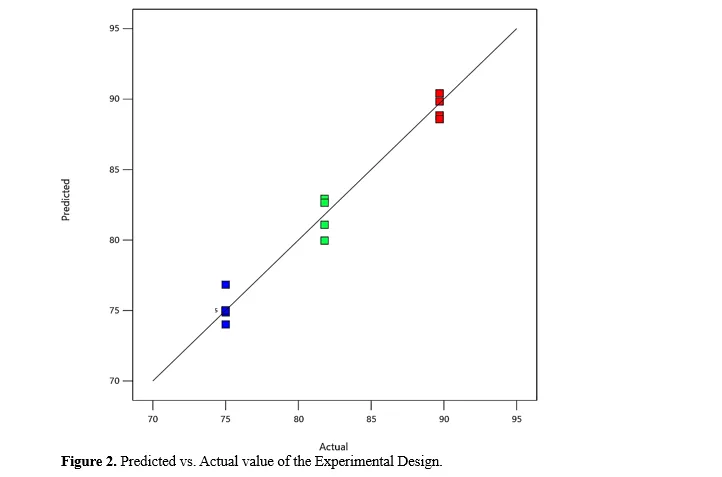
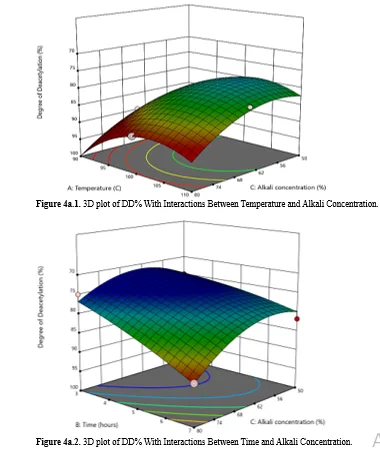
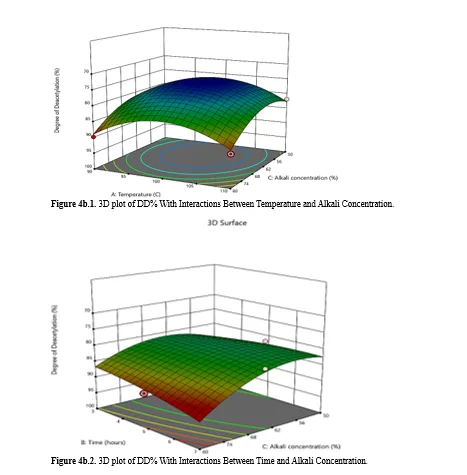
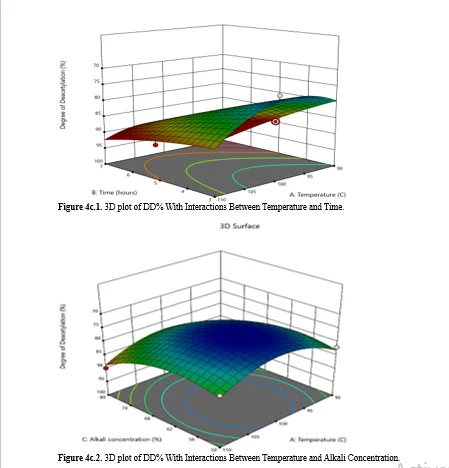
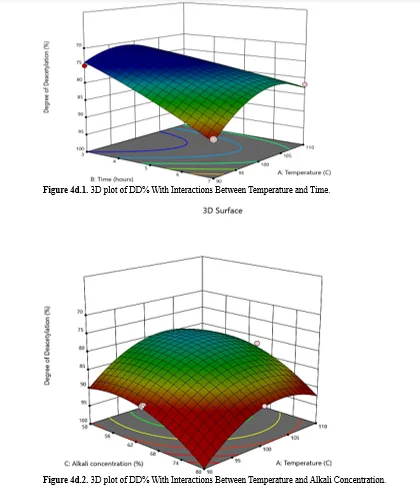
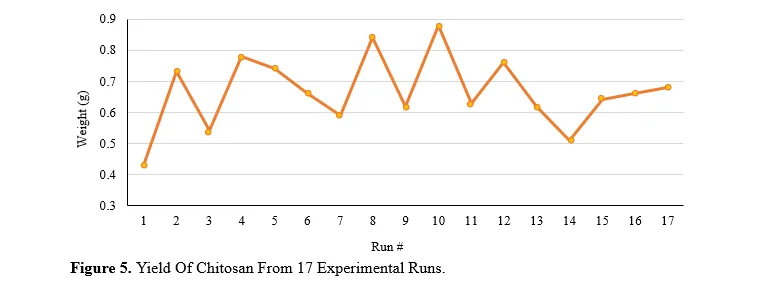
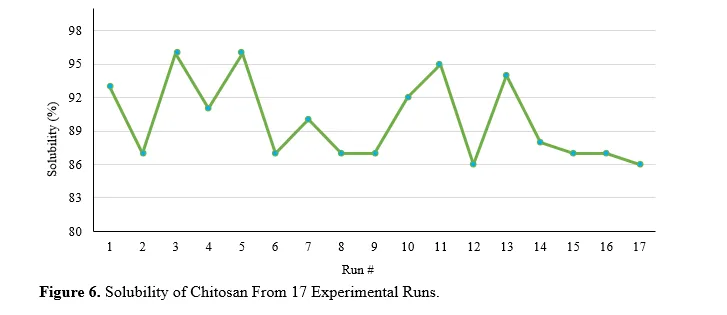
Chitosan, a versatile biopolymer derived from chitin, holds immense potential across various industries owing to its antimicrobial, antioxidant, and biocompatible properties. This study aims to optimize the deacetylation process of chitin, sourced from shrimp shells, using Response Surface Methodology (RSM) to produce high-quality chitosan. The Box-Behnken Design (BBD) was employed to evaluate the effects of temperature, time, and alkali concentration on the degree of deacetylation (DD%), a key determinant of chitosan’s functional properties. Seventeen experimental runs were conducted, and the data were analyzed using a quadratic model validated through ANOVA. The results revealed that time and alkali concentration significantly influenced DD%, with a notable interaction between these factors. Optimal conditions for deacetylation yielded chitosan with a DD% above 85%, ensuring enhanced solubility. The solubility ranged from 86% to 96%, strongly correlating with DD%. Additionally, the produced chitosan exhibited moisture content below 10% and ash content under 1%, meeting industrial quality standards. Residual analysis confirmed the model’s reliability, and 3D response surface plots illustrated the synergistic effects of the variables. This research highlights the effective use of RSM to optimize chitosan extraction, promoting the sustainable utilization of shrimp shell waste from seafood industries. The high-quality chitosan produced is suitable for applications in biomedicine, agriculture, and water treatment. This study underscores the importance of precise parameter control in enhancing chitosan’s properties and sets the groundwork for future exploration of alternative sources and tailored deacetylation processes.
Keywords: Box-Behnken design (BBD), chitin deacetylation, marine waste utilization, Shrimp shell, Chitosan.
[This article belongs to Journal of Polymer & Composites ]

References
- Hasan S, Boddu VM, Viswanath DS, Ghosh TK. Chitin and Chitosan. Science and Engineering. Cham, Switzerland: Springer Nature Switzerland AG. 2022.
- Akakuru OU, Louis H, Amos PI, Akakuru OC, Nosike EI, Ogulewe EF. The chemistry of chitin and chitosan justifying their nanomedical utilities. Biochem Pharmacol (Los Angel). 2018;7(241):2167–0501.
- Rameshthangam P, Solairaj D, Arunachalam G, Ramasamy P. Chitin and Chitinases: biomedical and environmental applications of chitin and its derivatives. Journal of Enzymes. 2018 May 5;1(1):20–43.
- Elsabee MZ, Morsi RE, Fathy M. Chemical modifications of chitin and chitosan. Encyclopedia of Marine Biotechnology. 2020 Aug 11; 2:885–963.
- Rege PR, Garmise RJ, Block LH. Spray-dried chitinosans: Part I: Preparation and characterization. International journal of pharmaceutics. 2003 Feb 18;252(1–2):41–51.
- Abuzar, Sharif HR, Sharif MK, Arshad R, Rehman A, Ashraf W, Karim A, Awan KA, Raza H, Khalid W, Asar TO. Potential industrial and nutritional applications of shrimp by-products: a review. International Journal of Food Properties. 2023 Dec 15;26(2):3407–32.
- Wang J, Zhuang S. Chitosan-based materials: Preparation, modification and application. Journal of Cleaner Production. 2022 Jun 25; 355:131825.
- Chen RH, Tsaih ML. Effect of temperature on the intrinsic viscosity and conformation of chitosans in dilute HCl solution. International journal of biological macromolecules. 1998 Aug 1;23(2):135–41.
- Premasudha P, Vanathi P, Abirami M. Extraction and characterization of chitosan from crustacean waste: A constructive waste management approach. Int. J. Sci. Res. 2017;6(7):1194–8.
- Puvvada YS, Vankayalapati S, Sukhavasi S. Extraction of chitin from chitosan from exoskeleton of shrimp for application in the pharmaceutical industry. International Current Pharmaceutical Journal. 2012 Aug 4;1(9):258–63.
- Black WA, Blakemore WR, Colquhoun JA, Dewar ET. The evaluation of some red marine algae as a source of carrageenan and of its κ‐and λ‐components. Journal of the Science of Food and Agriculture. 1965 Oct;16(10):573–85.
- Ben-Gigirey B, Rodríguez-Velasco ML, Gago-Martínez A. Extension of the validation of AOAC official method SM 2005.06 for dc-GTX2, 3: Interlaboratory study. Journal of AOAC International. 2012 Jan 1;95(1):111–21.
- Takarina ND, Nasrul AA, Nurmarina A. Degree of deacetylation of chitosan extracted from white snapper (Lates sp.) scales waste. Int. J. Pharma Med. Biol. Sci. 2017 Jan 1;6(1):16–9.
- Shahri FB, Niazi A. Synthesis of modified maghemite nanoparticles and its application for removal of acridine orange from aqueous solutions by using Box-Behnken design. Journal of Magnetism and Magnetic Materials. 2015 Dec 15; 396:318–26.
- Tsai ML, Chen RH. Modifying the molecular weight of chitosan. In Chitosan Based Biomaterials Volume 1 2017 Jan 1 (pp. 135–158). Woodhead Publishing.
- Bi S, Qin D, Wang T, Sun S, Yuan S, Chen X. Effects of reaction environments on the structure and physicochemical properties of chitosan and its derivatives. Carbohydrate Polymers. 2023 Feb 1; 301:120357.
- Kumar S, Madihally SV, editors. Role of chitosan and chitosan-based nanomaterials in plant sciences. Academic Press; 2022 Aug 6.
- Mourya VK, Inamdar NN. Chitosan-modifications and applications: Opportunities galore. Reactive and Functional polymers. 2008 Jun 1;68(6):1013–51.
- Honarkar H, Barikani M. Applications of biopolymers I: chitosan. Monatshefte für Chemie-Chemical Monthly. 2009 Dec; 140:1403–20.
- Hossain S, Afrin S, Anika S, Sultana S, Haque P, Shahruzzaman MD. Synthesis, characterization, and modification of natural polysaccharides. InRadiation-Processed Polysaccharides 2022 Jan 1 (pp. 29–74). Academic Press.
- Methacanon P, Prasitsilp M, Pothsree T, Pattaraarchachai J. Heterogeneous N-deacetylation of squid chitin in alkaline solution. Carbohydrate Polymers. 2003 May 1;52(2):119–23.
- No HK, Meyers SP, Lee KS. Isolation and characterization of chitin from crawfish shell waste. Journal of Agricultural and Food Chemistry. 1989 May;37(3):575–9.
- No HK, Meyers SP. Preparation and characterization of chitin and chitosan—a review. Journal of aquatic food product technology. 1995 Oct 3;4(2):27–52.
- Austin PR, Brine CJ, Castle JE, Zikakis JP. Chitin: New facets of research. Science. 1981 May 15;212(4496):749–53.
- Khan TA, Peh KK, Ch’ng HS. Reporting degree of deacetylation values of chitosan: the influence of analytical methods. J Pharm Pharmaceut Sci. 2002 Sep 1;5(3):205–12.
- Li Q, Dunn ET, Grandmaison EW, Goosen MF. Applications and properties of chitosan. InApplications of Chitan and Chitosan 2020 Aug 18 (pp. 3–29). CRC Press.

Journal of Polymer & Composites
| Volume | 13 | |
| Issue | 01 | |
| Received | 26/09/2024 | |
| Accepted | 26/10/2024 | |
| Published | 11/11/2024 | |
| Publication Time | Days |