[email protected] (+91) 9218088240

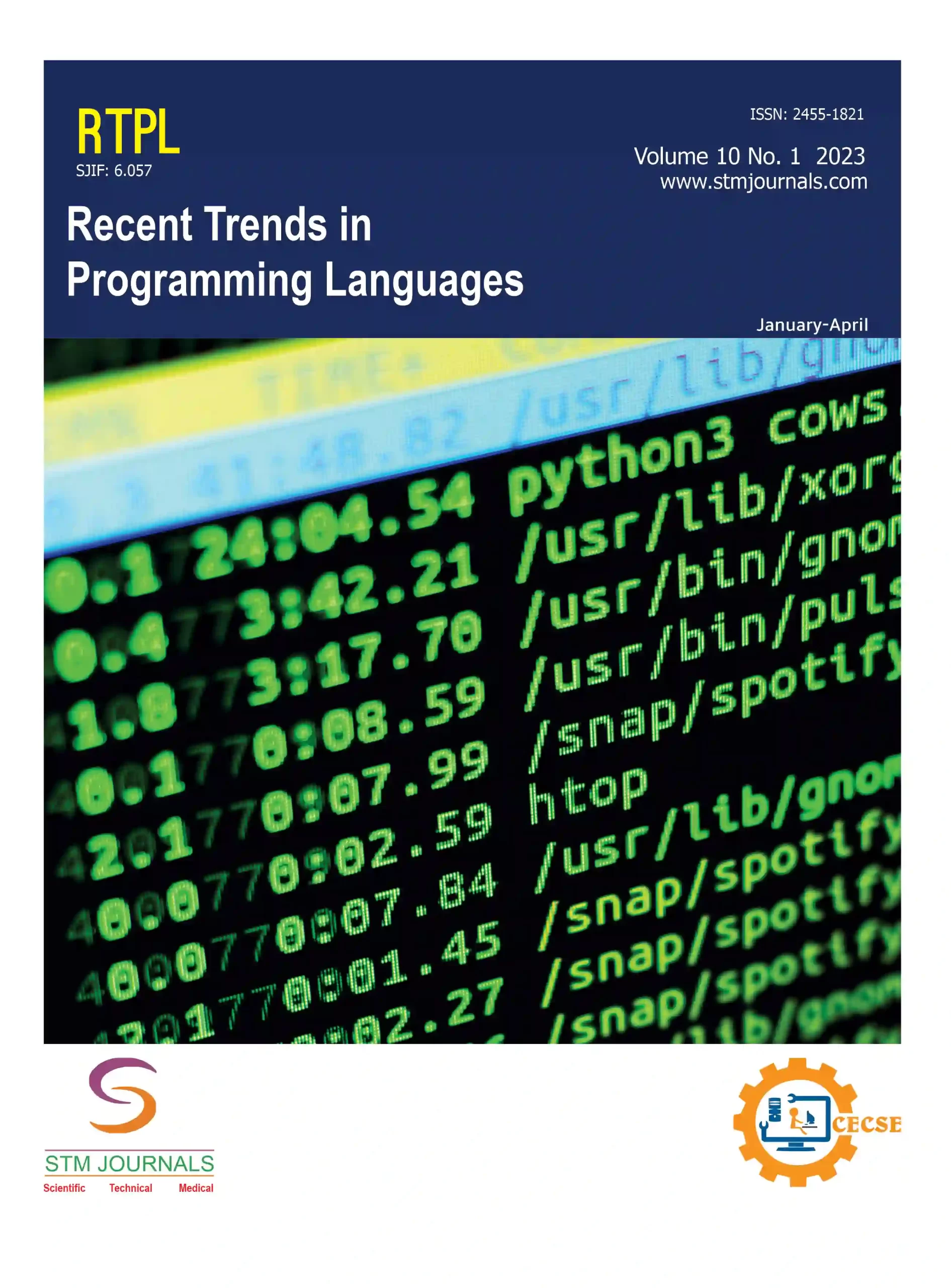
Recent Trends in Programming languages

rtpl | E-ISSN: 2455-1821 | Peer-Reviewed | Hybrid Open Access

About the Journal

Recent Trends in Programming languages Recent Trends in Programming languages [2455-1821(e)] is a peer-reviewed hybrid open-access journal launched in 2014 that has always been influenced by programming paradigms, which in turn have been characterized by general computing trends. Several … less common paradigms in programming languages, such as declarative or functional programming, emphasize high levels of expressiveness.

View full focus & scope More

Recent Trends in Programming languages (RTPL): 2455-1821(e) is a peer-reviewed hybrid open-access journal launched in 2014 that has always been influenced by

Journal Information

Title:
Recent Trends in Programming languages
Abbreviation:
RTPL
Issues Per Year:
3 Issues (Jan-April,May-August,Sept-Dec)
P-ISSN:
2455-1821
Publisher:
116314
DOI:
10.37591/RTPL
Starting Year:
2014
Subject:
Language:
English
Publication Format:
Hybrid Open Access
Copyright Policy:
CC BY-NC-ND
Type:
Peer-reviewed Journal (Refereed Journal)
Address:

Editorial Board

View Full Editorial Board

rtpl maintains an Editorial Board of practicing researchers from around the world, to ensure manuscripts are handled by editors who are experts in the field of study.

Editor in Chief

Editor

Dr. Debnath Bhattacharyya, Professor and Head

Vignan’s Institute of Information Technology, Andhra Pradesh, India,

Email :

Latest Articles

Programming Languages for Robotics: A Comprehensive Review of Applications, Features, and System Integration

The rapid advancement of industrial automation, artificial intelligence, and autonomous systems has increased the importance of effective programming approaches for modern robotic applications.

Robotics, robot programming, programming languages, C/C++, Python, Java;,C#/.NET, MATLAB, industrial robotics, artificial intelligence

AI-Assisted Programming, Memory Safety, Multi-Paradigm Design and Emerging Development Models

As the field of artificial intelligence (AI) continues to evolve at a fast pace, and specifically with the rise of large language models (LLMs), the software design, implementation, testing, and maintenance landscape has undergone unprecedented transformation.

Artificial intelligence, programming languages, large language models, AI-assisted programming, code generation, AI agents, software engineering, memory safety, human–AI collaboration

LLM-Assisted Programming: Trends, Evaluation Gaps, and Software Assurance

Large language models (LLMs) are increasingly used for code generation, software testing, program repair, and security analysis.

Large language models (LLMs), LLM-assisted programming, code generation, automated program repair, unit test generation, software security, code review, evaluation benchmarks, benchmark contamination, software assurance, quantum software engineering, cyber reasoning systems

Bug Tracking and Resolution System: A Rule-Based and Python-Driven Approach

The way things operate and how they will age from a performance and user interaction standpoint, what types of loads they can handle, and how maintenance will be needed in the future are all connected to how working out glitches affects the future and how it feels to the users.

Automated bug triaging, bug tracking and resolution, rule-based systems, Python-based systems, issue management, software engineering

AI-Native Programming Languages: Reconsidering Programming Language Selection in the Era of Generative AI and Autonomous Coding

The role of programming languages is undergoing a significant transformation as generative artificial intelligence becomes integrated into everyday software development.

Programming languages, generative artificial intelligence, AI coding agents, AI-assisted software development, python, typescript, rust, software engineering, language-agent affinity, verification debt

A Comprehensive Study of Natural Language Processing Systems Using Modern Programming Languages: Techniques, Architectures, Experimental Evaluation and Applications

Natural language processing is a key field of study within artificial intelligence that focuses on enabling machines to understand and work with human language.

Natural language processing (NLP), Object-oriented programming (OOP), ML/DL algorithm, transformers, bidirectional encoder representations from transformers (BERT), text mining, artificial intelligence

Login

Quick Actions

Current Issue

Volume 13, Issue 02, 2023

May-August


116314


APID Initiative

Academic Profile ID

Create your unique researcher identity with comprehensive academic profiling

Global Network
Track Impact

Learn More →

Submissions Open

NEW

Manuscript Submissions

December 2025

Virtual & Delhi, India

March 15-17, 2025

View All Events →

Support