
📢 Latest Update: UGC Discontinues CARE Journal Listing: New Guidelines for Selecting Peer-Reviewed Journals View Now

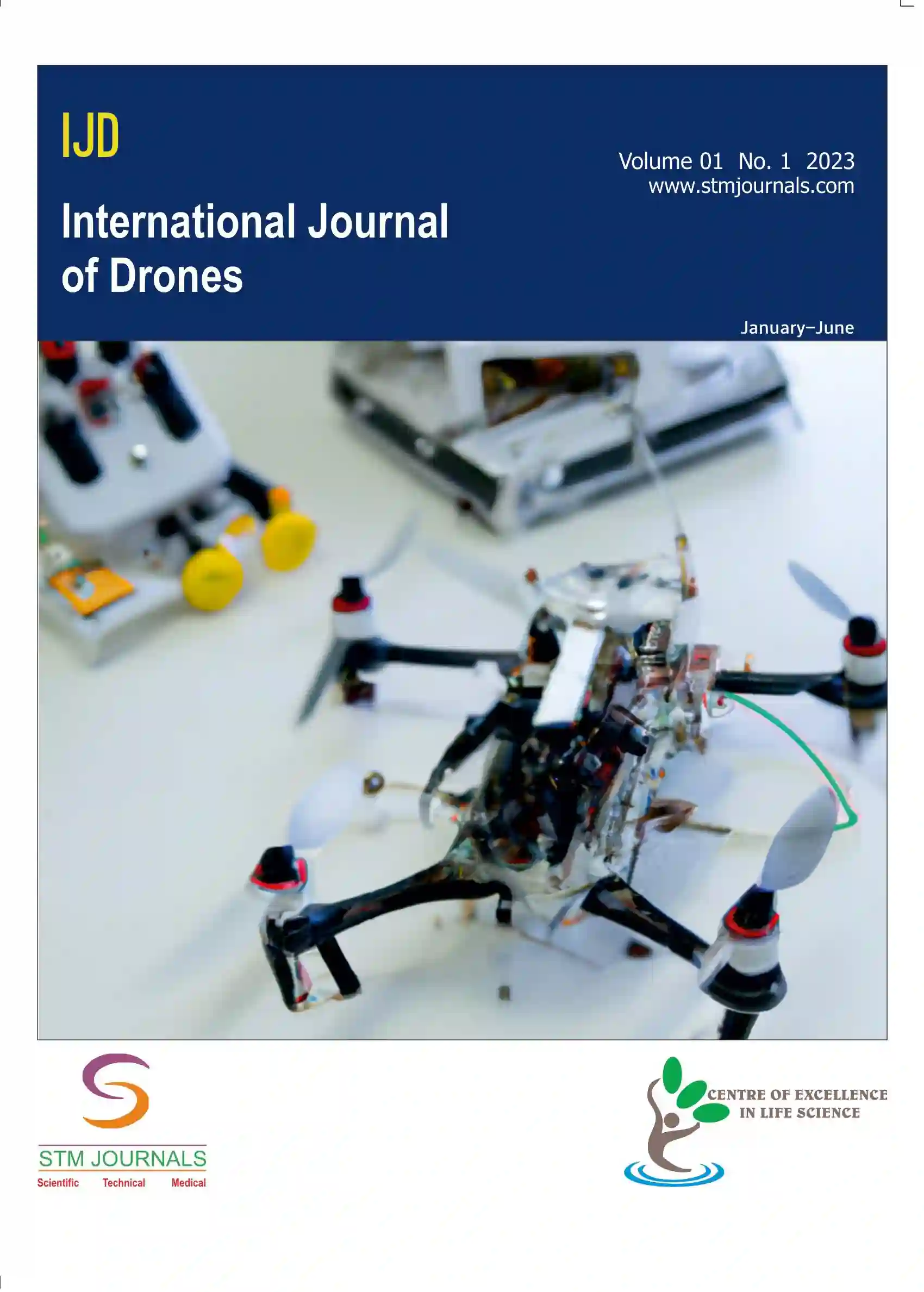
International Journal on Drones Cover

International Journal on Drones

| Peer-Reviewed Journal (Refereed Journal) | Hybrid Open Access

About the Journal

International Journal on Drones International Journal on Drones is a peer-reviewed open-access journal launched in 2025 that focuses on the latest developments, research, and applications related to drones and unmanned aerial vehicles (UAVs). The journal aims to provide a platform for researchers, engineers, practitioners, and students to publish high-quality papers on topics related to drones. The scope of the journal includes both theoretical and practical aspects of drone technology. The journal welcomes original research articles, reviews, case studies, and technical notes that present new findings and insights in the field of drones. Manuscripts that focus on innovative and interdisciplinary approaches to drone technology are highly encouraged.

View full focus & scope More

Journal Information

Title: International Journal on Drones
Abbreviation: ijd
Issues Per Year: 2 Issues
Publisher: STM Journals, An imprint of Consortium e-Learning Network Pvt. Ltd.
DOI: 10.37591/IJD
Starting Year: 2025
Subject: Drones
Publication Format: Hybrid Open Access
Language: English
Copyright Policy: CC BY-NC-ND
Type: Peer-reviewed Journal (Refereed Journal)

Address:

STM Journals, An imprint of Consortium e-Learning Network Pvt. Ltd. A-118, 1st Floor, Sector-63, Noida, U.P. India, Pin - 201301

Editorial Board

View Full Editorial Board

ijd maintains an Editorial Board of practicing researchers from around the world, to ensure manuscripts are handled by editors who are experts in the field of study.

Editor in Chief

Editor

Dr. K. VASUDEVAN, Head of Department

VLB Janakiammal College of Arts and Science, Coimbatore, Tamil Nadu,

Email :

Institutional Profile Link:

Journal: International Journal on Drones

Latest Articles

Ahead of Print

Trends, Challenges, and the Future of Unmanned Aerial Systems

The rapid evolution of unmanned aerial vehicles (UAVs), commonly referred to as drones, has transformed numerous domains — from military surveillance and logistics to precision agriculture and atmospheric research.

drones, unmanned aerial vehicles (UAVs), regulation, applications, autonomy, international standards

The Future of Farming with IoT-Operated Drones

The integration of Internet of Things (IoT) technology with drone systems has revolutionized precision agriculture, offering innovative solutions to address the inefficiencies and environmental concerns linked to conventional pesticide application.

IoT-Operated Drones, unmanned aerial vehicles, multispectral cameras, Internet of Things (IoT), algorithms

Electronic Drones: Technology, Applications, and Future Directions

Electronic drones, commonly referred to as Unmanned Aerial Vehicles (UAVs), have transitioned from exclusively military platforms to indispensable tools across commercial, scientific, industrial, and recreational domains.

Unmanned Aerial Vehicles (UAVs), radio transmitters, electronic speed controllers (ESCs), inertial measurement units (IMUs), Internet of Drones (IoD)

Optimization of Pesticide Requirement Calculations for IoT-Operated Hexacopter Delivery Systems

The integration of Internet of Things (IoT) technology into precision agriculture has transformed pesticide application strategies, enabling resource-efficient and environmentally sustainable practices.

Dosage, Hexacopter, IoT, pesticide, spray patterns

Aerodynamic Optimization of UAV Wings Using Machine Learning

Unmanned Aerial Vehicles (UAVs) are increasingly deployed across defense, transportation, agriculture, and environmental monitoring, demanding improved aerodynamic efficiency to enhance endurance, stability, and payload capacity.

Aerodynamic optimization, airfoil shape optimization, computational fluid dynamics (CFD), machine learning (ML), unmanned aerial vehicles (UAVs), wing geometry design

Emerging Role of Drone Technologies in Environmental Research: Trends, Applications, and Future Directions

Unmanned aerial vehicles (UAVs), commonly called drones, have rapidly transformed environmental research and management over the past decade. Their flexibility, improving sensor payloads, and ability to collect high-resolution spatial and temporal data make them powerful tools across disciplines — from biodiversity monitoring and precision agriculture to water quality assessment and disaster response.

Unmanned aerial vehicles (UAVs), environmental monitoring, remote sensing, drone applications, sustainable resource management