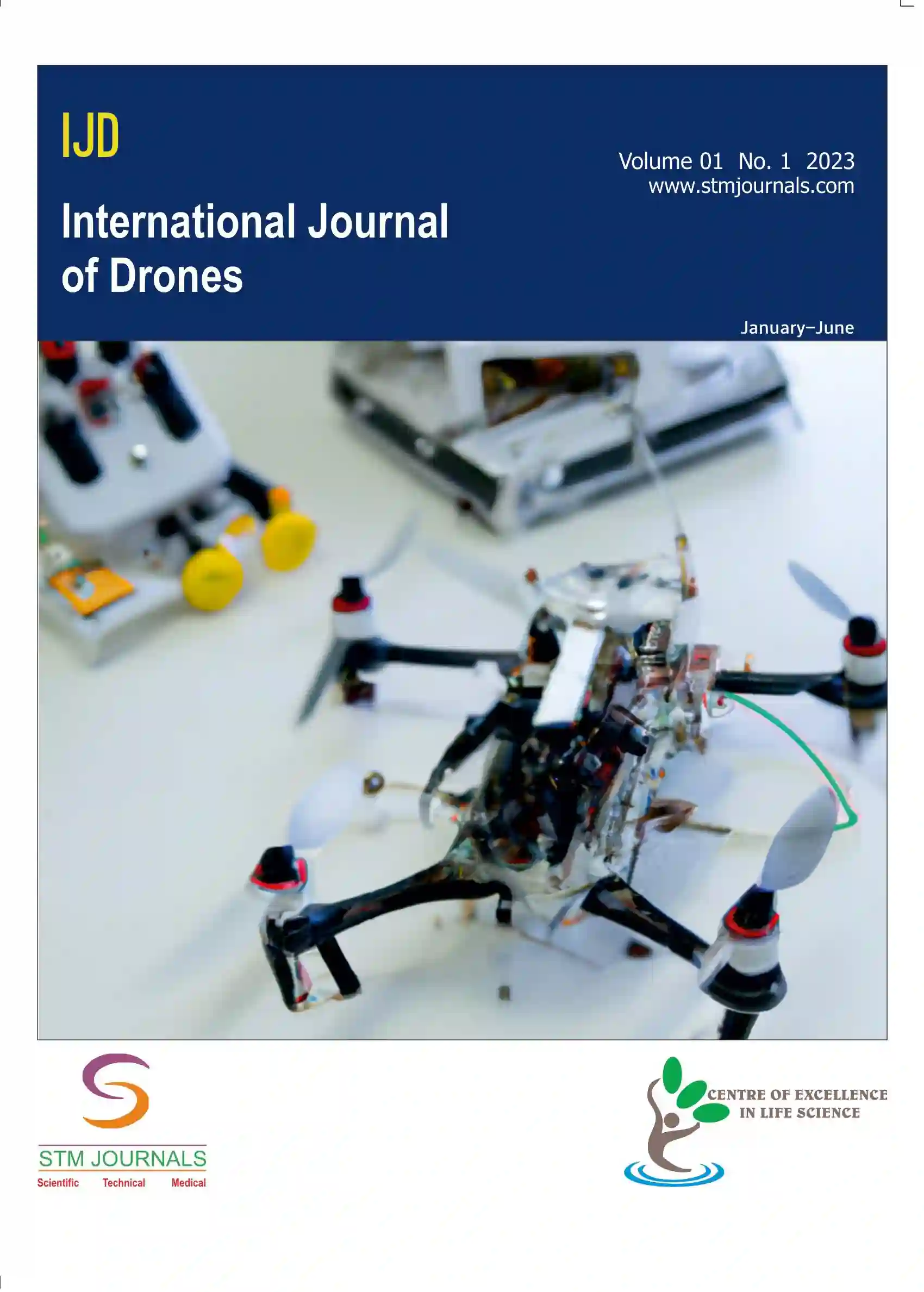
About the Journal
International Journal on Drones is a peer-reviewed Online journal launched in 2025 that focuses on the latest developments, research, and applications related to drones and unmanned aerial vehicles (UAVs). The journal aims to provide a platform for researchers, engineers, practitioners, and students to publish high-quality papers on topics related to drones. The scope of the journal includes both theoretical and practical aspects of drone technology. The journal welcomes original research articles, reviews, case studies, and technical notes that present new findings and insights in the field of drones. Manuscripts that focus on innovative and interdisciplinary approaches to drone technology are highly encouraged.
Focus & Scope
The journal welcomes contributions across the following topic areas:
- Drone Design, Development & Control: drone platform design and architecture, quadcopter and rotorcraft design, fixed-wing drone development, hybrid and innovative configurations, drone propulsion systems and motors, flight dynamics and control, autonomous flight and autonomy, stability and attitude control, sensor integration and processing, payload design and integration, power systems and battery management, drone materials and structures, drone testing and validation, simulation and prototyping, and field demonstrations
- Agricultural & Environmental Applications: precision agriculture and crop monitoring, crop mapping and crop health analysis, plant counting and biometric measurement, soil mapping and characterization, irrigation management and optimization, forestry management and monitoring, tree detection and measurement, forest fire detection and prevention, environmental monitoring and assessment, pollution tracking and detection, climate change monitoring, coastal and marine mapping, habitat monitoring and conservation, wildlife tracking and census, anti-poaching applications, and precision land management
- Drone Sensing & Data Acquisition: aerial photography and photogrammetry, remote sensing and image acquisition, LiDAR and 3D point cloud generation, hyperspectral and multispectral imaging, thermal imaging and infrared sensing, synthetic aperture radar, aerial surveying and topographic mapping, 3D mapping and reconstruction, data fusion and integration, machine learning for image analysis, computer vision and object detection, change detection and monitoring, anomaly detection and classification, feature extraction and segmentation, and data processing and quality assurance
- Autonomous Delivery & Logistics: last-mile delivery and e-commerce applications, medical and emergency delivery systems, disaster relief and humanitarian response, package and cargo transport, urban air mobility concepts, autonomous flight and route planning, flight path optimization and efficiency, drone swarm coordination, fleet management and operations, charging and battery management, autonomous docking and launch, regulatory compliance and airspace integration, safety systems and redundancy, and deployment case studies and outcomes
- Drone Communication & Swarm Systems: drone-to-drone communication networks, mesh and ad hoc networking, multi-agent coordination systems, swarm intelligence and algorithms, flocking and collective behavior, decentralized control architectures, mission planning and execution, task allocation and optimization, distributed computing on drones, wireless communication standards, network topology and routing, latency and reliability management, security and encryption, scalability and large swarms, and experimental validation and testing
- Safety, Security & Regulations: drone safety systems and protocols, airworthiness and certification standards, flight safety and incident investigation, safety culture and training programs, cyber security and attack mitigation, physical security and tampering prevention, privacy protection and data security, geofencing and no-fly zone enforcement, identification and tracking systems, counter-drone technologies and policies, airspace integration and traffic management, regulatory frameworks and compliance, legal aspects and liability, insurance and risk management, and standards development
- Drone-Human Interaction & Social Dimensions: human factors and ergonomics, user interface and experience design, public perception and acceptance, privacy concerns and mitigation, noise and visual impact assessment, ethical considerations in deployment, cultural and social acceptance, community engagement and outreach, educational programs and training, journalism and media applications, artistic and creative uses, recreational and sports applications, entertainment and performance, accessibility and inclusive design, and stakeholder communication
- Advanced Autonomy & Artificial Intelligence: autonomous decision-making systems, path planning and navigation, obstacle detection and avoidance, GPS-denied navigation and localization, computer vision for autonomous flight, machine learning algorithms and optimization, deep learning applications, reinforcement learning for control, real-time processing and edge computing, adaptive and learning systems, fail-safe and redundancy mechanisms, and real-world performance validation
Keywords
unmanned aerial vehicles, drone design, autonomous flight, drone applications, precision agriculture, swarm robotics, aerial sensing, drone delivery, drone safety, computer vision