
📢 Latest Update: UGC Discontinues CARE Journal Listing: New Guidelines for Selecting Peer-Reviewed Journals View Now

[email protected] (+91) 1204746 270
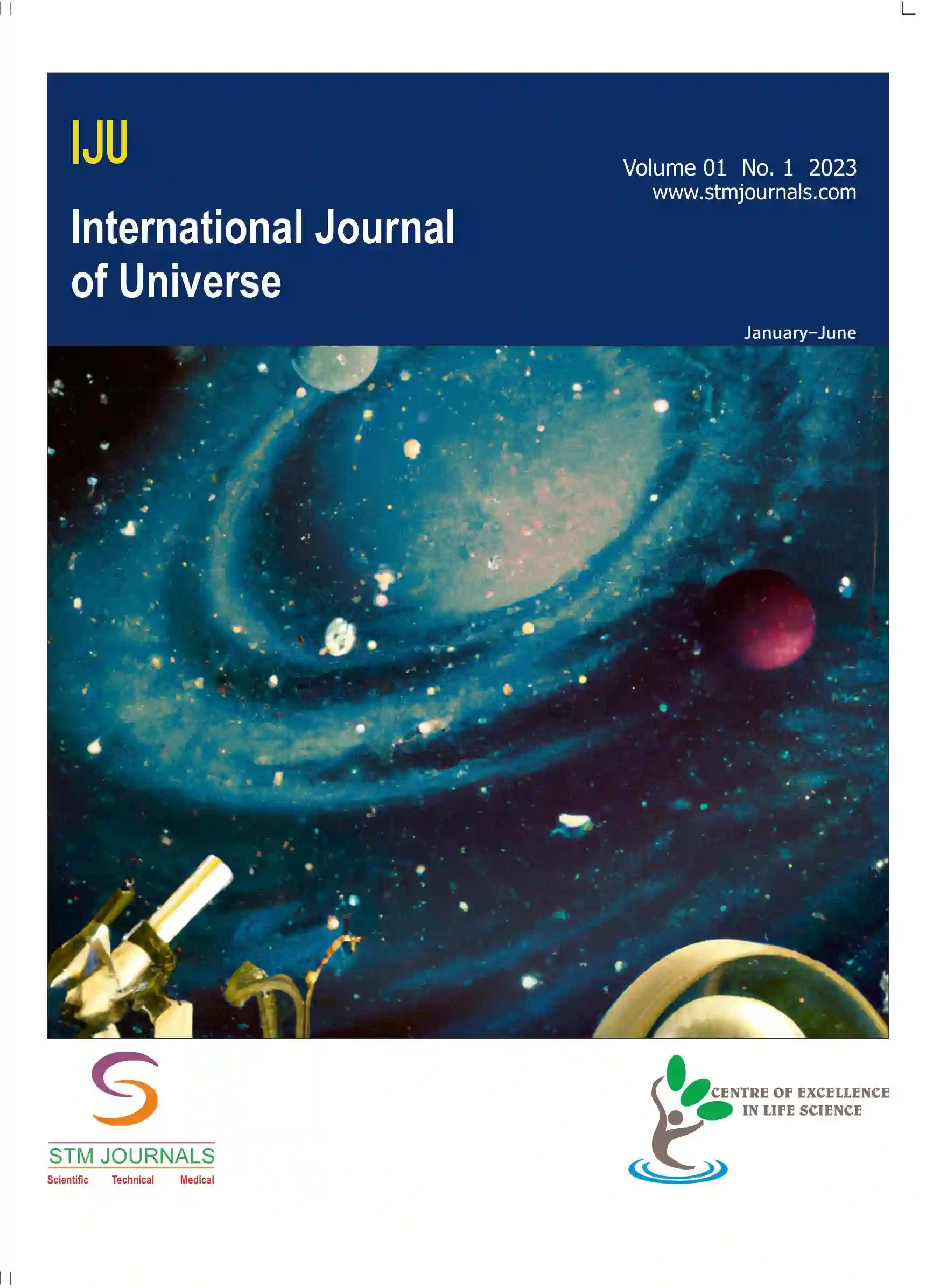
International Journal of Universe Cover

International Journal of Universe

| Peer-Reviewed Journal (Refereed Journal) | Hybrid Open Access

About the Journal

The International Journal of Universe is a peer-reviewed open-access journal launched in 2025, dedicated to the study of the universe and its components, including galaxies, stars, planets, black holes, dark matter, and cosmic microwave background radiation. The journal aims to publish original research articles, review articles, and letters in all areas of astrophysics, cosmology, and related fields. The International Journal of Universe welcomes contributions from researchers all over the world and encourages interdisciplinary research. The journal is committed to publishing high-quality research papers, reviews, and letters that advance our understanding of the universe and its components.

View full focus & scope More

Journal Information

Title: International Journal of Universe
Abbreviation: iju
Issues Per Year: 2 Issues
Publisher: STM Journals
DOI: 10.37591/IJU
Starting Year: 2025
Subject: Universe
Publication Format: Hybrid Open Access
Copyright Policy: CC BY-NC-ND
Type: Peer-reviewed Journal (Refereed Journal)

Address:

STM Journals, An imprint of Consortium e-Learning Network Pvt. Ltd. A-118, 1st Floor, Sector-63, Noida, U.P. India, Pin - 201301

Editorial Board

View Full Editorial Board

iju maintains an Editorial Board of practicing researchers from around the world, to ensure manuscripts are handled by editors who are experts in the field of study.

Editor in Chief

Editor

Dr. Dil Nawaz Khan, Controller of Examination

Pak-Austria Fachhochschule: Institute of Applied Sciences & Technology Khanpur Road Mang, Haripur, Pakistan,

Email :

Institutional Profile Link: https://paf-iast.edu.pk/

Journal: International Journal of Universe

Latest Articles

Ahead of Print

Debris Flow Kinetics in Planetary Environments: A Systems Perspective

Debris flow kinetics in planetary environments represent a critical intersection of geomorphology, fluid mechanics, and planetary science. These gravity-driven flow mixtures of solids, liquids, and gases play a key role in shaping planetary surfaces and recording environmental histories.

Debris flow kinetics, planetary geomorphology, systems modeling, rheology, mars

Modeling Galaxy Formation in a Hierarchical Universe: A Fiducial Approach and Comparison with Observational Data

We have developed a detailed model to understand how galaxies form in the framework of hierarchical theories of structure formation. Our model accounts for key processes like the formation and merging of dark matter halos, the heating and cooling of gas inside these halos, the regulation of star formation driven by energy from evolving stars and supernovae, galaxy mergers, and the changes in star populations over time.

Galaxy formation, dark matter halos, star formation, galaxy mergers, cold dark matter (CDM)

A New Computational Method for Dust and Gas Dynamics in Protoplanetary Discs

The simultaneous evolution of dust and gas in protoplanetary discs regulates essential events in planet formation, such as dust accumulation, migration, and the initiation of gravitational instabilities. Nevertheless, precisely modelling this interaction continues to provide a significant computing problem owing to the extensive variety of spatial and temporal scales involved.

Protoplanetary discs, Dust-gas dynamics, Hydrodynamical simulations, Planet formation, Numerical methods, Aerodynamic drag

Physical Modeling of Mass Transport Processes in Extraterrestrial Landscapes

Currently the progress in physical models based on mass transport in both the Earth's surface and extraterresterial landscape has been growing. It is a frame work involving different natural and made made processes including aeline process, fluid flow process, magmal movement, Geomagnetic stroms, and clould flow modesl etc.

Aeolian process, cloud process, Extraterrestrial landscape, Geomagnetic strom, magmal movement, Mass transport, Physical models.

Unified Mass–Energy Dissolution Cosmology (UMEDC): A Staged Framework for Cosmic Energy Transformation and Late-Time Acceleration

The ΛCDM model successfully describes the universe’s expansion but remains fundamentally descriptive: it assigns fixed densities to matter, dark matter, and dark energy without providing a unifying physical mechanism behind their coexistence or evolution. In this work, we introduce the Unified Mass–Energy Dissolution Cosmology (UMEDC), a novel framework based on the staged transformation M → DM → DE, where ordinary matter gradually dissolves into a dark-matter-like reservoir, which subsequently transforms into a vacuum-like dark energy component. This mass-to-energy drift is governed by small, constant dissolution parameters that preserve early-universe cosmology while naturally generating late-time acceleration.

Cosmology; Dark energy; Dark matter; Mass loss; Variable mass cosmology; Friedmann equations; Energy transformation; UMEDC; Modified expansion history; Cosmic acceleration; Structure formation; Energy policy of the universe.

Cutting- Edge Gravitational-Wave Detectors: Technology & Innovations

Gravitational wave detectors using laser interferometry are sophisticated instruments designed to measure the ripples in spacetime caused by cosmic events such as the merging of black holes or neutron stars.

Gravitational waves, Interferometry, LIGO (Laser Interferometer Gravitational-Wave Observatory), Virgo, KAGRA (Kamioka Gravitational Wave Detector)