
📢 Latest Update: UGC Discontinues CARE Journal Listing: New Guidelines for Selecting Peer-Reviewed Journals View Now

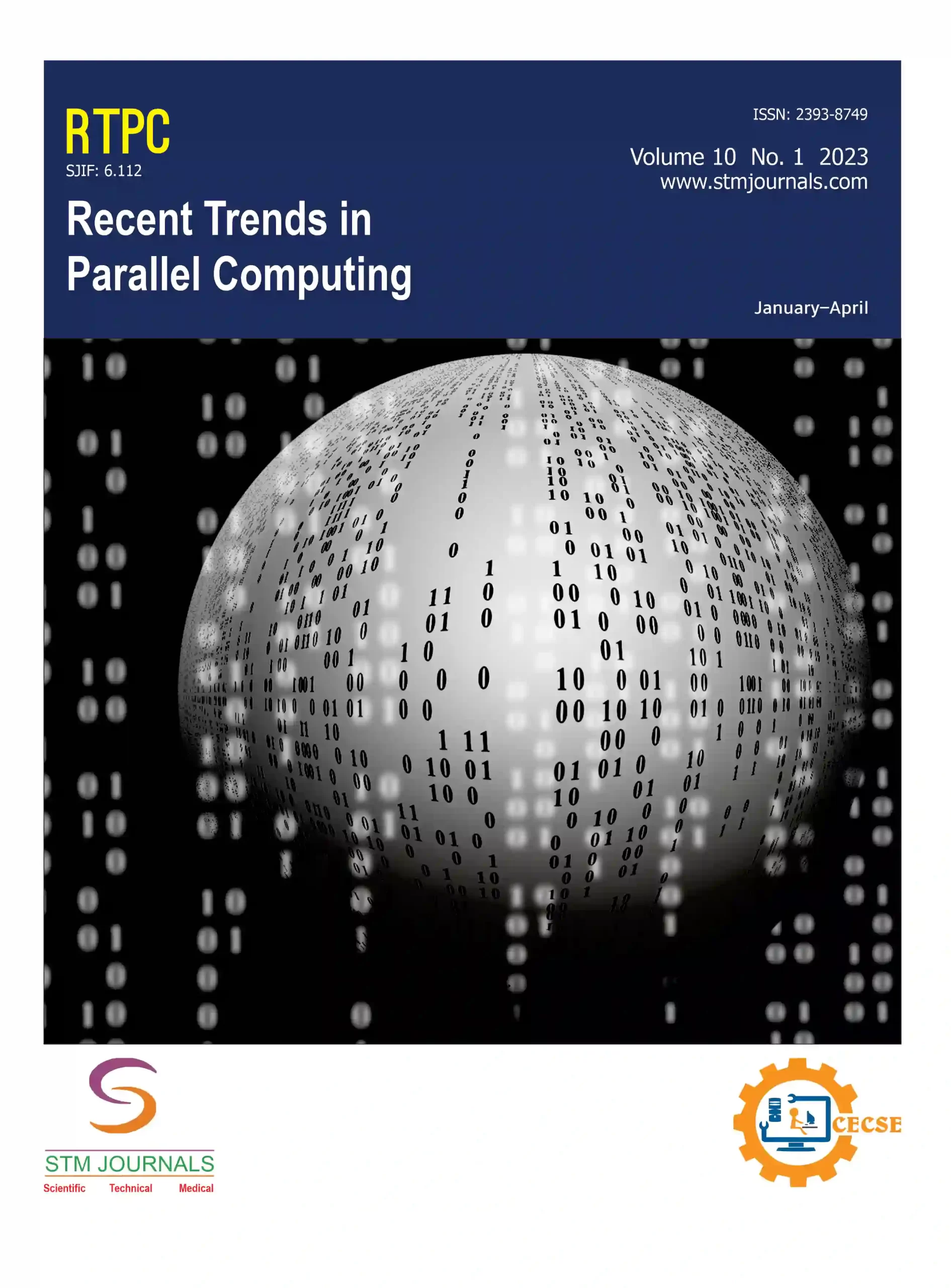
Recent Trends in Parallel Computing Cover

Recent Trends in Parallel Computing

E-ISSN: 2393-8749 | Peer-Reviewed Journal (Refereed Journal) | Hybrid Open Access

About the Journal

Recent Trends in Parallel Computing Recent Trends in Parallel Computing [2393-8749(e)] is a peer-reviewed hybrid open-access journal launched in 2014. Parallel computing is a form of computation in which many calculations can be done at the same time and it works on the principle that … large problems can often be divided into smaller ones, which are then solved in parallel. Specialized parallel computer architectures are sometimes used aboard traditional processors, to quicken specific tasks this increases the speed of execution of the task.

View full focus & scope More

Journal Information

Title: Recent Trends in Parallel Computing
Abbreviation: rtpc
Issues Per Year: 3 Issues
E-ISSN: 2393-8749
Publisher: STM Journals, An imprint of Consortium e-Learning Network Pvt. Ltd.
DOI: 10.37591/RTPC
Starting Year: 2014
Subject: Parallel Computing
Publication Format: Hybrid Open Access
Language: English
Copyright Policy: CC BY-NC-ND
Type: Peer-reviewed Journal (Refereed Journal)

Address:

STM Journals, An imprint of Consortium e-Learning Network Pvt. Ltd. A-118, 1st Floor, Sector-63, Noida, U.P. India, Pin - 201301

Editorial Board

View Full Editorial Board

rtpc maintains an Editorial Board of practicing researchers from around the world, to ensure manuscripts are handled by editors who are experts in the field of study.

Editor in Chief

Editor

Prof. Pinaki Mitra, Associate Professor

Indian Institute of Technology, Guwahati, Assam, India,

Email :

Latest Articles

Ahead of Print

Energy-Efficient Parallel Computing for Edge Devices: Techniques, Challenges, and Emerging Research Directions

Edge computing brings computation closer to data sources, which supports low-latency applications but places substantial demands on energy-constrained and heterogeneous devices.

Edge computing, parallel computing, energy efficiency, heterogeneous architectures, task scheduling, DVFS, task offloading, hardware acceleration

Memory Reclamation Behavior Under cgroups v2 Versus Legacy cgroups: A Measurement Framework for Containerized Workloads

Linux control groups (cgroups) are the kernel mechanism that lets container runtimes such as Docker, containerd, and CRI-O enforce per-container CPU, memory, and I/O limits.

cgroups, memory management, container runtime, Linux kernel, resource isolation, container density, reclaim pressure, PSI

A Comparative Review of Parallel Computing Techniques for High-Performance Computing

High-Performance Computing (HPC) has become an essential technology for solving computationally intensive problems in scientific computing, engineering, artificial intelligence, weather forecasting, computational biology, financial modelling, and large-scale data analytics.

High-performance computing, parallel computing, MPI, OpenMP, CUDA, OpenACC, SYCL, Kokkos, RAJA, performance portability, heterogeneous computing

Polyhedral Compilation for Imperative Loops: Foundations, Advances, and Emerging Frontiers

Polyhedral compilation is a mathematically rigorous framework that models imperative loop nests as sets of integer points constrained by affine inequalities, enabling precise reasoning about data dependences and the legality of complex program transformations.

Polyhedral compilation; loop transformation; affine scheduling; data dependence analysis; high-performance computing

A Hierarchical Orchestration Framework for Parallelized Multi-Entity Web Ingestion and NoSQL Synchronization

In the current EdTech sector, gathering structured data from various fragmented web portals is a major challenge for building reliable, real-time data systems.

Hierarchical orchestration, parallel ETL, Web ingestion, NoSQL, MongoDB, data engineering, scalability, master–slave architecture, fault tolerance, edtech data systems

A Review Study on CPU-Optimized Parameter-Efficient Fine-Tuning for Large Language Models to Increase Accuracy Using LoRA

The fast proliferation of large language models (LLMs) has increased the need to optimize the process of fine-tuning, but the existing workflows that require a graphics processing unit (GPU) are still expensive, intensive, and unavailable to most researchers.

AI efficiency, CPU optimization, LLMS, LoRA, low-rank adaptation, model compression, parameter-efficient fine-tuning
Support